
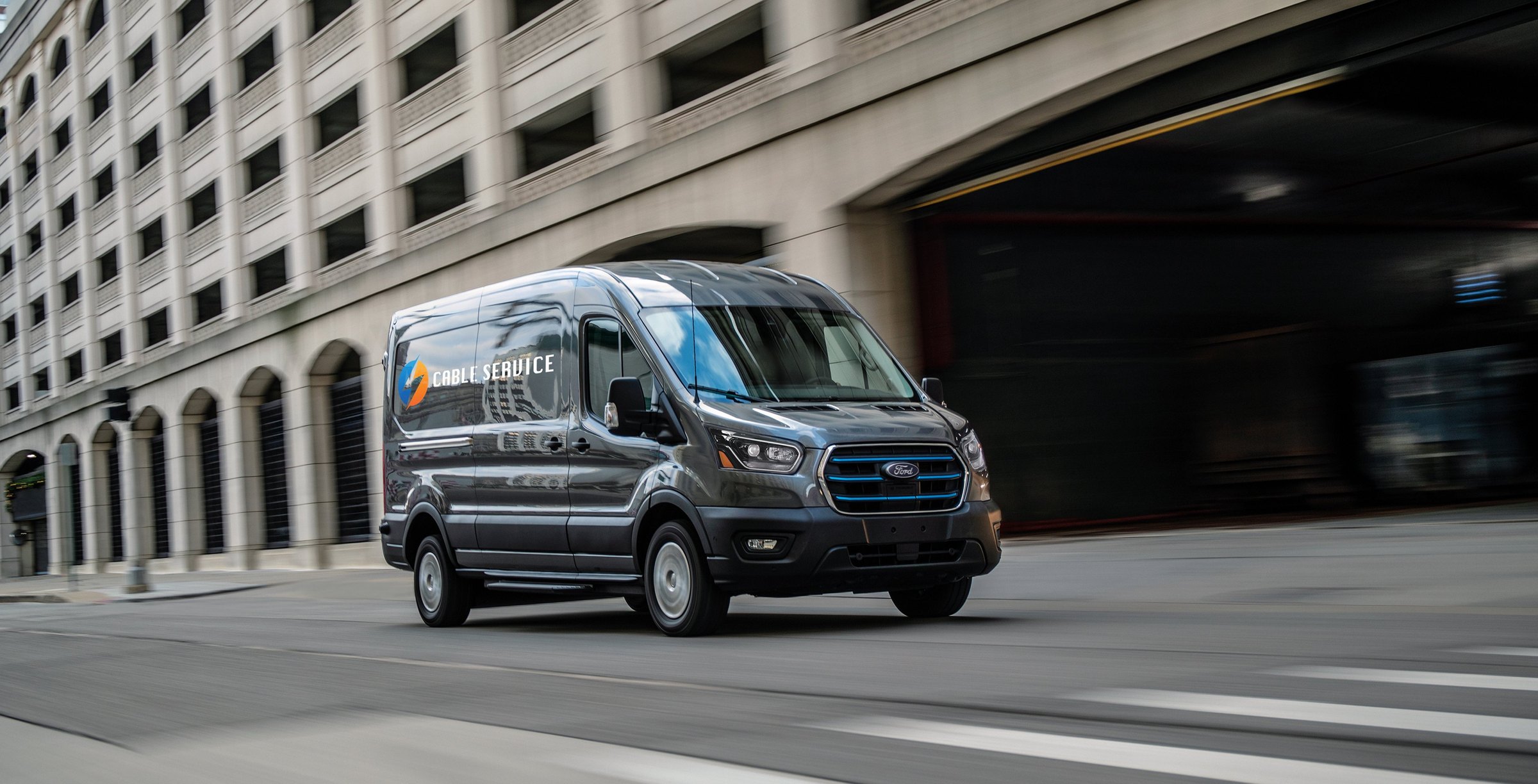
2027 Eight configurations · all-electric · Huntley, IL
The 2027 Ford E-Transit.Ford says the average van day is 74 miles.
Ford analyzed 2.5 million commercial-van trips and found the average day is 74 miles. The E-Transit is rated at up to 159. That one comparison decides whether this van is right for your business, and it is Ford’s own number on both sides.
- 159 miles
- Ford’s targeted range · not an EPA rating
- $54,260
- Cargo Van, plus $2,395 destination
- 8
- Configurations, against 38 on the gas Transit
Cargo Van from $54,260, Cutaway from $48,150, plus $2,395 destination · Ford’s MSRPs, read Sept. 5, 2026
Starting MSRP is Ford’s own published price for the 2027 E-Transit Cargo Van, read from ford.com in a rendered browser on Sept. 5, 2026, and excludes the $2,395 destination and delivery charge, taxes, title, license and the dealer documentary fee. The 159-mile figure is Ford’s targeted range for the Enhanced Range battery, published on fordpro.com and read the same day — the EPA has never rated an E-Transit, so there is no window-sticker range to quote. The 74-mile figure is Ford’s own, from a telematics study of more than 2.5 million trips totaling 30 million miles.
159 miles of range against a 74-mile average day
Everything else about this van is a detail. If your routes fit inside the battery, the E-Transit is a straightforward buy. If they do not, no amount of torque or cargo volume fixes it — and we will point you at the gas Transit instead.
Ford’s own number, not ours
From Ford Pro’s E-Transit page, word for word: “Leveraging Ford Telematics data, we analyzed more than 2.5 million trips, totaling 30 million miles, to understand that the average daily range for commercial vans in the U.S. is 74 miles.” That is the most useful sentence Ford publishes about this vehicle, and most dealers bury it.
Up to 159 miles on a charge
Ford’s figure for the Enhanced Range battery — an 89 kWh useable pack, the only one offered. That is 85 miles of headroom over the average van day, which is what makes the arithmetic work for most fleets even after a cold morning and a heavy load have taken their share.
But there is no EPA range figure at all
We checked fueleconomy.gov’s complete Ford lists for 2026 and 2025. They contain the Mustang Mach-E and, for 2025, the F-150 Lightning — and no Transit and no E-Transit of any kind. There is no 2027 Ford data yet. So 159 miles is Ford’s targeted figure, not a rating anyone independent has verified, and we would rather say that than print it as though the government had signed it off.
The number that decides it is yours
Not ours and not Ford’s. Pull a month of route data — most fleet software will export it in a couple of clicks — and look at the longest day, not the average one. If your worst day is inside about 120 miles you have real margin. If it is 180, you are asking the van to do something it cannot, in February, with the heater on.

Routes that end where they started
The E-Transit is built around a pattern rather than a promise: leave a depot, work a territory, come back, plug in overnight. Parcel and courier work, plumbing and electrical rounds inside a county, municipal fleets, shuttle and service routes with a fixed base — all of it sits comfortably inside 159 miles. What it is not built for is the open-ended day. No mid-shift fill-up in four minutes, no 400-mile run to a job two states over, and no towing a loaded trailer to the edge of the range and back. Ford does not publish a towing rating for the E-Transit at all, which tells you what it is for. The honest test is the one above: your longest routine day, not your average one. We will happily sit down with a month of your route data and do that arithmetic with you before anyone talks about a price, because getting this wrong is expensive in a way that getting a trim level wrong is not.
Range and telematics figures from fordpro.com’s 2026 E-Transit pages, read Sept. 5, 2026. Ford publishes a single “up to 159 miles” figure and no per-roof or per-configuration range, so this page prints no per-configuration range either. Range varies with load, temperature, terrain, driving style, accessory use and battery age; cold weather in particular reduces it materially. The EPA publishes no range or MPGe rating for any E-Transit.
Ford prints the whole E-Transit range on one page
The gas Transit runs to 38 configurations across four series, three roof heights, three lengths and two drivelines. The electric one is a much shorter list, and that is the second thing worth knowing before you shop it.
| Body type | Roof | Length and wheelbase | Body code |
|---|---|---|---|
| Cargo Van | Low | Long, 148 in | W1Y |
| Cargo Van | Medium | Long, 148 in | W9C |
| Cargo Van | High | Long, 148 in | W1X |
| Cargo Van | High | Extended, 148 in | W3X |
| Chassis Cab | Low | Long, 156 in | W5Z |
| Chassis Cab | Low | Extended, 178 in | W5Z |
| Cutaway | Low | Long, 156 in | W5P |
| Cutaway | Low | Extended, 178 in | W5P |
One series, one weight rating
Every E-Transit is a T-350 with a 9,500 lb gross vehicle weight rating and a single rear wheel. There is no T-150, no T-250 and no T-350HD, so the series decision that drives the whole gas Transit conversation simply does not exist here. It also means the electric van cannot reach the 11,000 lb GVWR a T-350HD can.
Rear-wheel drive only
The gas Transit offers intelligent all-wheel drive across the range. The E-Transit does not offer it at all. In Illinois that matters: an empty rear-drive van in February is the least confident thing on the road, and the fix here is weight in the back and good winter tires rather than a driveline option.
No regular-length van
The smallest gas Transit is a regular-length body at 246.7 cubic feet. There is no electric equivalent — the E-Transit cargo van starts at the Long body and 277.7 cubic feet. If you were running the shortest Transit because it parks in tight city streets, the electric one is a bigger vehicle than the one you have.
And no passenger van
The E-Transit is a Cargo Van, a Chassis Cab or a Cutaway. There is no 12- or 15-seat electric wagon. If you are moving people rather than freight, the electric option does not exist and the conversation is about the gas Passenger Van instead.
Configuration table transcribed from the E-TRANSIT CONFIGURATIONS page of the 2026 Ford Transit Order Guide, 04/30/26, published by Ford and read Sept. 5, 2026. Ford has published no separate E-Transit order guide or technical specification for either 2026 or 2027 — every filename we tried under fromtheroad.ford.com returns a 404 — so the Transit order guide, which carries a full E-Transit column throughout, is the source. Ford revises availability during the model year.
The chassis cab carries most, and the cargo van carries least
That order surprises people, and it is worth understanding before you order. Payload is gross vehicle weight rating minus what the van weighs empty — and an 89 kWh battery is heavy.
| Body and roof | Length and wheelbase | Gross vehicle weight rating | Maximum payload |
|---|---|---|---|
| Cutaway, low roof | Long, 156 in | 9,500 lb | 4,201 lb |
| Chassis Cab, low roof | Long, 156 in | 9,500 lb | 4,200 lb |
| Cutaway, low roof | Extended, 178 in | 9,500 lb | 4,063 lb |
| Chassis Cab, low roof | Extended, 178 in | 9,500 lb | 4,025 lb |
| Cargo Van, low roof | Long, 148 in | 9,500 lb | 3,320 lb |
| Cargo Van, medium roof | Long, 148 in | 9,500 lb | 3,170 lb |
| Cargo Van, high roof | Long, 148 in | 9,500 lb | 3,074 lb |
| Cargo Van, high roof | Extended, 148 in | 9,500 lb | 2,869 lb |
| Length and roof | Behind the first row | With the passenger seat removed | Difference from the smallest |
|---|---|---|---|
| Long, low roof | 277.7 cu ft | 311.9 cu ft | — |
| Long, medium roof | 357.1 cu ft | 400.5 cu ft | 79.4 cu ft more |
| Long, high roof | 404.3 cu ft | 453.4 cu ft | 126.6 cu ft more |
| Extended, high roof | 487.2 cu ft | 536.4 cu ft | 209.5 cu ft more |

Space is the same; weight is not
Put the E-Transit’s cargo volumes beside the gas Transit’s and they match, body for body — 277.7, 357.1, 404.3 and 487.2 cubic feet are the same shells. The battery lives under the floor, so it costs you nothing in space. It costs you in weight. The best electric cargo van carries 3,320 lb, which sits at the bottom of the gas cargo van’s 3,195 to 5,103 lb range. A gas T-250 will take 4,146 lb and a T-350HD 5,103 lb, and no E-Transit gets near either. If you regularly load past about three thousand pounds, that is the whole answer. The chassis cab and cutaway are the other way round because they are sold without a body: 4,200 and 4,201 lb on the 156-inch wheelbase, before an upfitter builds anything onto the back. Whatever that body weighs comes straight off the number. One more caution. Ford’s own marketing page says “a maximum overall payload of 4,063 lbs” while Ford’s own specification table shows 4,201 lb on the 156-inch cutaway. We print the table. Either way, the figure that governs your van is on the label in its door jamb.
Payload, gross vehicle weight ratings and cargo volumes from Ford Pro’s 2026MY Ford E-Transit Vehicle Specifications, an eight-page Ford Pro document read Sept. 5, 2026; the copy read was the one published by California HVIP, a state incentive program, because Ford Pro renders the same content client-side. Gas Transit payload figures are from the 2026 Ford Transit Technical Specifications. Maximum payload applies to a properly equipped base vehicle and varies with accessories and configuration — the figure that governs a specific van is printed on the label in its door jamb. Chassis cab and cutaway payloads are before any upfit body. Always properly secure cargo.
- 89kWh of useable battery, the only pack offered
- 266Horsepower, with 317 lb-ft of torque
- 8Years of coverage on the electrified components
One motor, one battery, one way to charge it
There is no powertrain decision to make on an E-Transit. What there is instead is a charging decision, and it is the one that takes planning.
| Item | Figure | Note | Choice |
|---|---|---|---|
| Electric motor | 198 kW, 266 hp | Rear-mounted | None offered |
| Torque | 317 lb-ft | Available from a standstill | None offered |
| Battery | 89 kWh useable | High-voltage lithium-ion | None offered |
| Transmission | Single-speed | No gears to shift | None offered |
| Driveline | Rear-wheel drive | Single rear wheel, T-350 | None offered |
| Top speed | Governed to 75 mph | Cargo Van, standard | Not removable |
| Item | What Ford publishes | Standard or optional | What it means |
|---|---|---|---|
| Charge port | SAE J1772 CCS | Standard | The Combined Charging System plug, not NACS |
| Charging inputs | 120V, 240V and DC fast charge | Standard | Wall socket, Level 2, or a public fast charger |
| Level 2 peak rate | 11.2 kW | Standard | The figure that matters for overnight depot charging |
| Onboard charger | Single | Standard, new for 2026 | A dual onboard charger is optional |
| NACS adapter | Mobile Power Cord and Fast Charging Adapter bundle | Optional | 120V/240V, for the Tesla-style connector |
| DC fast-charge time | Ford publishes none | — | We are not going to invent one |
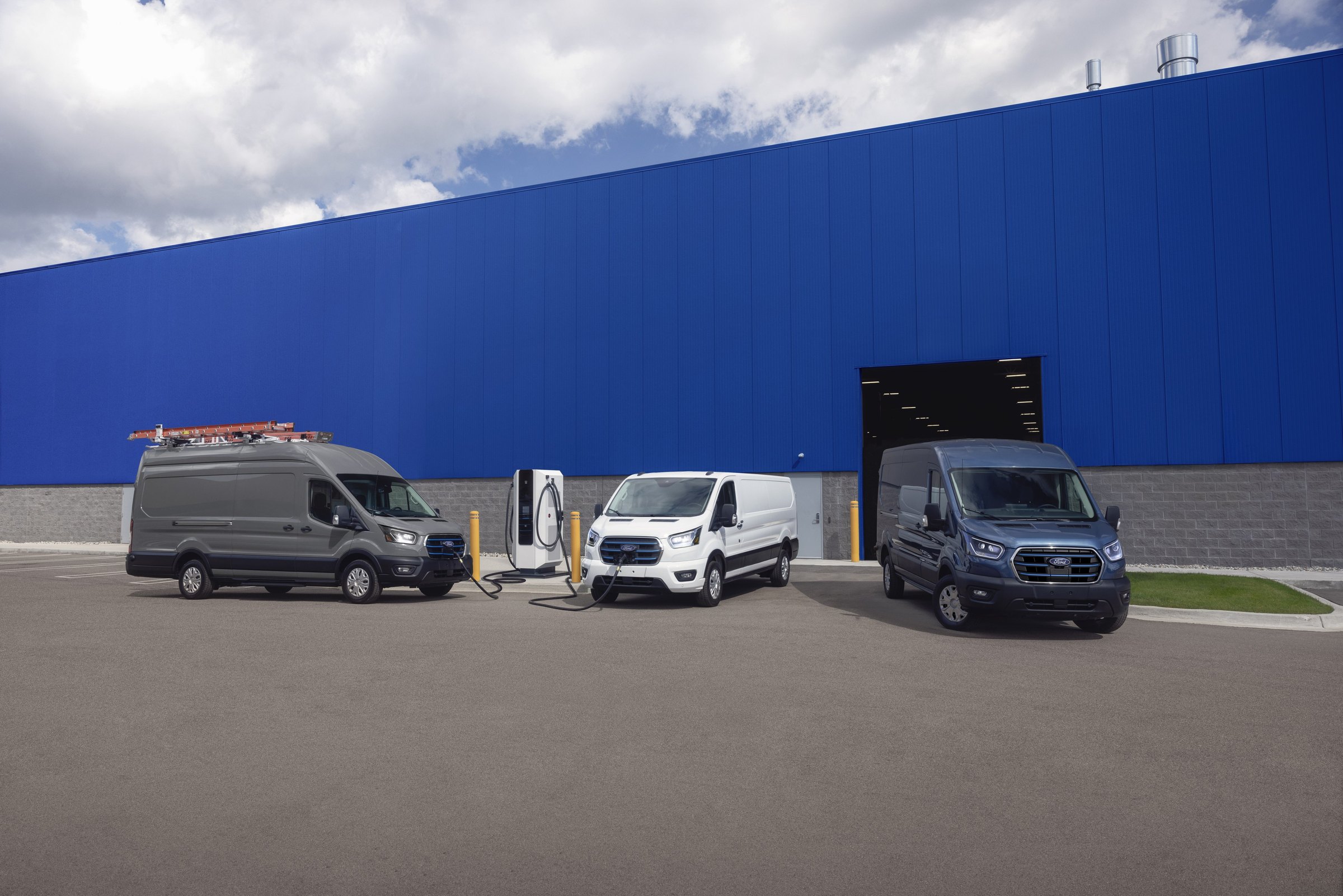
Where it charges is a bigger decision than which one you buy
A Level 2 charger at 11.2 kW puts roughly a full day’s driving back into an E-Transit overnight, which is exactly how the vehicle is meant to be used. That is the good news. The rest is a building problem rather than a vehicle problem. One van in a yard with a spare 240-volt circuit is straightforward. Four vans on one panel is an electrical contractor, a load calculation and possibly a utility service upgrade, and that work takes longer to arrange than the van takes to arrive. If you are considering more than one, start the charging conversation first and the vehicle conversation second. If the van goes home with an employee overnight, the question is who pays for the electricity and what happens when that employee moves house. Fleets that have not settled this in writing before the first delivery generally end up settling it badly afterwards. And the port is CCS, not the Tesla-style NACS connector. Ford sells an adapter bundle as an option, so the Tesla network is reachable, but it is an accessory rather than a native fitting.
Charging specifications from the “Charging (E-Transit only)” section of the 2026 Ford Transit Order Guide, 04/30/26, and motor and battery figures from Ford Pro’s 2026MY E-Transit Vehicle Specifications, both read Sept. 5, 2026. Ford publishes no DC fast-charge time and no peak DC kilowatt figure in either document, so this page quotes neither. Note that the Highlights table on Ford Pro’s own page repeats “198kW / 266 HP” in its torque row; the engine specification table on the same document gives torque as 317 lb-ft, which is the figure used here. Charging times vary with charger output, battery temperature and state of charge.
The two cheapest E-Transits are the ones without a body
Ford publishes a starting price for all three E-Transit body styles — which is more than it does for the gas Transit, where the Chassis Cab and Cutaway are quoted rather than listed.
| Body style | Starting MSRP | With destination | Model year Ford publishes |
|---|---|---|---|
| E-Transit Cargo Van | $54,260 | $56,655 | 2027 |
| E-Transit Cargo Van | $53,260 | $55,655 | 2026 |
| E-Transit Chassis Cab | $48,650 | $51,045 | 2026 |
| E-Transit Cutaway | $48,150 | $50,545 | 2026 |
$1,000 more for 2027
That is the whole published price change on the Cargo Van, and it is the only body style Ford lists a 2027 price for. Its card on ford.com offers Build and Price rather than Search Inventory, which is the tell that the 2027 is orderable rather than leftover stock. The Chassis Cab and Cutaway prices above are Ford’s 2026 figures, because Ford publishes no 2027 ones we can reach.
$5,860 more than the gas Cargo Van
A 2027 Transit Cargo Van starts at $48,400 and the electric one at $54,260. That gap is the number the fuel and maintenance saving has to pay back, and with the federal credit gone it has to pay it back on its own. How long that takes depends entirely on your miles and your electricity rate, which is a conversation rather than a headline.
Why the cutaway is cheapest
Because you are not buying a body. A Cutaway is a cab, a chassis and a battery, and everything behind the seats — box, service body, refrigeration, whatever the job needs — is built by an upfitter and quoted separately. The $48,150 is a real Ford price for an unfinished vehicle, not a finished one.
The 2027 Cargo Van price was read from ford.com’s 2027 Transit lineup page in a rendered browser on Sept. 5, 2026. The 2026 Cargo Van, Chassis Cab and Cutaway prices were read the same day from fordpro.com’s E-Transit pages, which are headed 2026. All exclude the $2,395 destination and delivery charge, taxes, title, license and the dealer documentary fee, and all exclude the cost of any upfit body on a Chassis Cab or Cutaway. The gas Transit Cargo Van comparison price is Ford’s published 2027 figure. Ford can change pricing at any time.
The $7,500 federal credit no longer exists
This is the single most important thing on this page.
What the IRS says, in its own words
“The Qualified Commercial Clean Vehicle Credit is not available for vehicles acquired after Sept. 30, 2025.” That is the Section 45W credit — the $7,500 a business could claim on a van like this one. It ended under Public Law 119-21, enacted July 4, 2025. A vehicle put into service after that date qualifies only if it was acquired on or before September 30, 2025 under a binding written contract with a payment made.
So the arithmetic changed
An E-Transit Cargo Van is $5,860 above the gas one. Until last autumn a federal credit covered that gap and more. It does not now, so the case for the electric van has to be made on fuel, maintenance and the way it drives — which is a harder argument, and the only honest one left.
ComEd still has a program, and Huntley is ComEd territory
ComEd’s Business and Public Sector EV Rebate Program runs through 2028 with more than $81 million in rebates for commercial and public-sector fleets, on new, pre-owned and repowered battery electric vehicles, with a post-purchase application route. It is a real program and it is local to us.
But read the class column carefully
The E-Transit is a Class 2 vehicle at 9,500 lb GVWR. On ComEd’s BE Plan 2 base tier, Class 2 is listed as not applicable — no rebate. On the low-income-community and equity-investment-eligible-community tier it is $10,000. The difference is where your fleet is based, not what you buy, and it is worth checking your address before you assume either number.
| Vehicle class | Base rebate | LIC/EIEC rebate | Where the E-Transit sits |
|---|---|---|---|
| Class 1 | Not applicable | $7,500 | — |
| Class 2 | Not applicable | $10,000 | The E-Transit, at 9,500 lb GVWR |
| Class 3 | $7,500 | $15,000 | — |
| Class 4 | $22,500 | $45,000 | — |
Federal credit status quoted from the IRS Commercial Clean Vehicle Credit page, read Sept. 5, 2026. We are a car dealership and not a tax adviser: the rule above is what the IRS publishes, and how it applies to your business is a question for your accountant. ComEd rebate amounts are from ComEd’s Business and Public Sector Electric Vehicle Rebate Program page, read the same day; the table is the BE Plan 2 rebate schedule and shows the four lightest of its thirteen columns. LIC/EIEC means a low-income community or equity investment eligible community as ComEd defines it — eligibility depends on location and we cannot confirm it for you. Program terms, funding and eligibility change; confirm with ComEd before relying on any figure here.
Nobody has crash-tested it, and there is an open battery recall
Both halves of that sentence are matters of public record, and both belong on the page. Every figure below is NHTSA’s or the IIHS’s own.
NHTSA rates it Not Rated, across the board
The agency lists the 2026 Ford Transit Van BEV and records Not Rated against the overall rating, frontal crash, side crash and rollover alike. The 2025 is the same. That is not a poor result — it means the tests have not been run. A blank is not a pass, and buyers should know the difference.
The IIHS does not crash-test it either
The institute does not crash-test the Transit family at all; its commercial-vehicle program says plainly that crash testing is not performed. The nearest thing that exists is its assessment of the 2025 gas Transit T250, which found the van lacks an effective driver seat belt reminder. That is the gas vehicle, and we cite it as the closest available evidence rather than as an E-Transit result.
An open recall on the high-voltage battery
NHTSA campaign 26V062000, reported March 2, 2026. Ford’s own words: bolts inside the high-voltage battery pack may be missing washers, “which can cause high electrical resistance or electrical arcing.” The consequence Ford states is an increased risk of fire, and a possible loss of drive power. Dealers inspect and repair the busbar fasteners and replace the busbar if necessary, free of charge. Ford’s number for it is 26S05.
And a trailer-module recall shared with half the range
NHTSA campaign 26V104000 covers the 2026 E-Transit alongside the F-150, Super Duty, Maverick, Ranger and others: the integrated trailer module may lose communication with the vehicle, causing a loss of trailer lights or brake function — a Federal Motor Vehicle Safety Standard 108 non-compliance. The remedy is a software update, at a dealer or over the air. Ford’s number is 26C10.
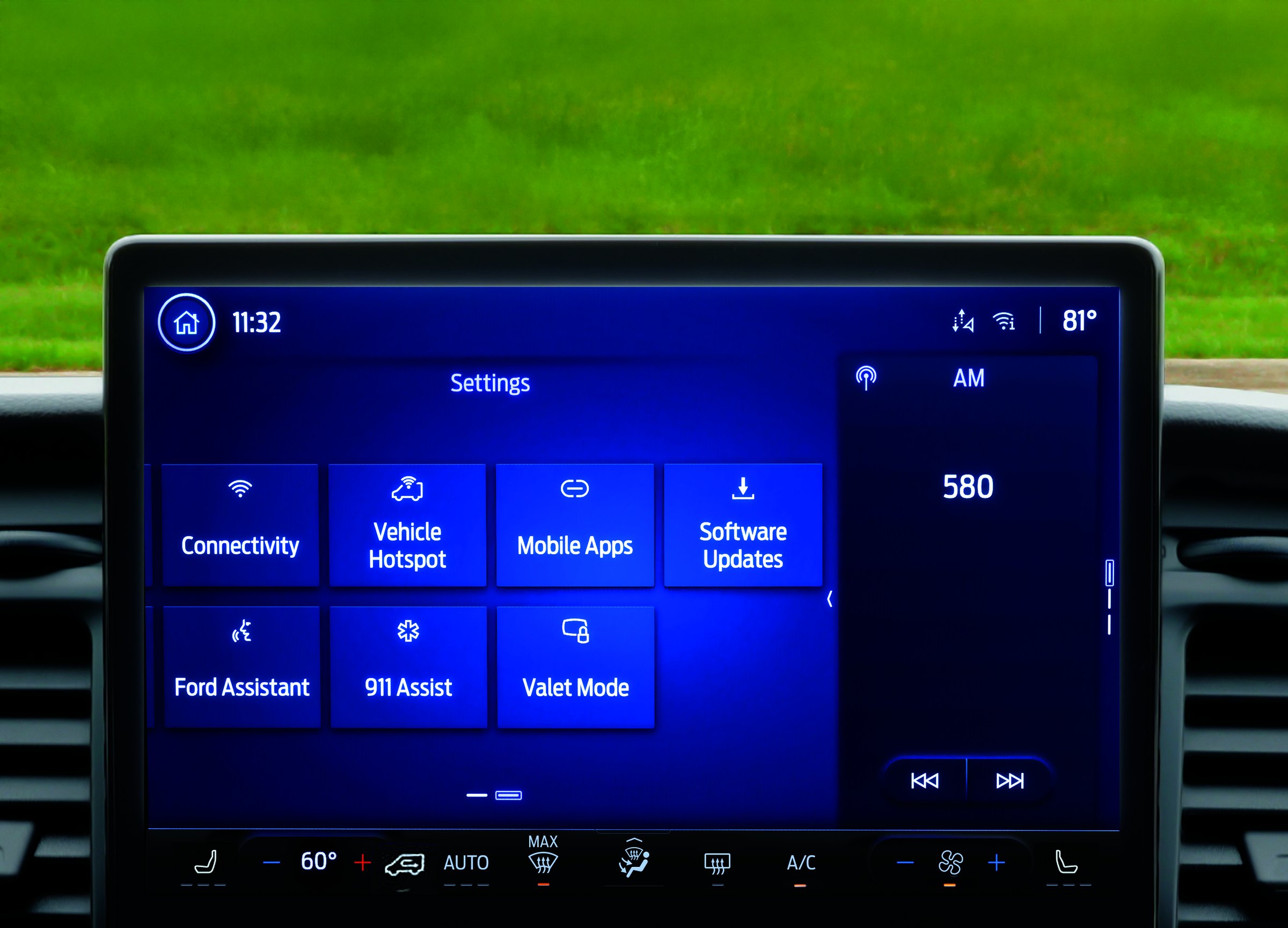
The driver aids are standard; the good ones are not
Ford Co-Pilot360 is standard on the E-Transit Cargo Van: automatic high beams, camera-only Evasive Steering Assist, the Lane-Keeping System and Pre-Collision Assist with Automatic Emergency Braking, plus Post-Collision Braking. SYNC 4 with a 12-inch display, an 8-inch cluster showing battery level and a power gauge, keyless push-button start, a 5G modem and heated front seats are all standard too, and the E-Transit gets high-intensity discharge headlamps where the gas van gets halogens. What is optional is the set most drivers would actually notice: Adaptive Cruise Control, the Blind Spot Information System with Cross Traffic Alert, the 360-degree camera and Co-Pilot360 Assist 2.0. On a vehicle with no rear window and a long blind spot on both sides, blind spot monitoring is the box we would tick first, and it is worth checking whether the van in front of you has it. Two more that matter on a work van: Pro Power Onboard is optional and rated at 120 volts and 2.4 kW, and a dual onboard battery charger is optional where a single one is standard. Ford also offers Electrician, HVAC and General Contractor trade packages from the factory, which are usually cheaper than paying an upfitter separately.
NHTSA ratings from the agency’s Safety Ratings API for the 2026 Ford Transit Van BEV, read Sept. 5, 2026; NHTSA has published no 2027 ratings for any Ford. Recall summaries, consequences and remedies are quoted from NHTSA’s recalls API, campaigns 26V062000 and 26V104000, read the same day. A recall may or may not apply to a specific vehicle — check the VIN at nhtsa.gov/recalls or ask us and we will check it for you. IIHS findings are from its commercial-vehicle driver-protection evaluation of the 2025 Ford Transit T250; the IIHS states that crash testing is not performed in that program. Standard and optional equipment from the 2026 Ford Transit Order Guide, 04/30/26.
The E-Transit in numbers
From Ford’s own documents, with the gaps left as gaps.
| Specification | 2027 Ford E-Transit |
|---|---|
| Body | |
| Body styles | Cargo Van · Chassis Cab · Cutaway |
| Series | T-350, single rear wheel, on every configuration |
| Roof heights | Low · Medium · High, cargo van only |
| Wheelbases | 148 in cargo van · 156 and 178 in chassis cab and cutaway |
| Configurations Ford builds | 8 |
| Seating | 2 |
| Powertrain | |
| Motor | 198 kW electric, 266 hp |
| Torque | 317 lb-ft |
| Battery | 89 kWh useable, high-voltage lithium-ion |
| Transmission | Single-speed |
| Driveline | Rear-wheel drive only |
| Top speed | Governed to 75 mph on the Cargo Van |
| Range and charging | |
| Ford targeted range | Up to 159 miles |
| EPA rating | None published — the EPA rates no E-Transit |
| Charge port | SAE J1772 CCS |
| Charging inputs | 120V · 240V · DC fast charge |
| Level 2 peak charging rate | 11.2 kW |
| Onboard charger | Single standard · dual optional |
| DC fast-charge time | Ford publishes none |
| Capability | |
| Gross vehicle weight rating | 9,500 lb, every configuration |
| Maximum payload, Cutaway | 4,201 lb |
| Maximum payload, Chassis Cab | 4,200 lb |
| Maximum payload, Cargo Van | 3,320 lb |
| Cargo volume behind the first row | 277.7 to 487.2 cu ft |
| Maximum cargo volume | 311.9 to 536.4 cu ft |
| Towing | Ford publishes no rating |
| Chassis | |
| Front suspension | Independent MacPherson strut with stabilizer bar |
| Rear suspension | Independent, coil springs, semi-trailing arm and stabilizer bar |
| Brakes | Four-wheel anti-lock disc |
| Steering | Electric power assisted |
| Wheels and tires | 16-inch · 235/65R16C |
| Standard equipment | |
| Driver aids | Ford Co-Pilot360 · Pre-Collision Assist with AEB · Lane-Keeping System · Post-Collision Braking |
| Display | SYNC 4 with a 12-inch center screen · 8-inch cluster with battery level and power gauge |
| Also standard | Keyless push-button start · 5G modem · HID headlamps · heated front seats · vapor injection heat pump |
| Notable options | Pro Power Onboard 120V/2.4 kW · adaptive cruise · blind spot monitoring · 360-degree camera · dual onboard charger · NACS adapter bundle |
| Warranty | |
| Unique electrified components | 8 years or 100,000 miles |
| Price | |
| Starting MSRP | $48,150 Cutaway to $54,260 Cargo Van |
| Destination and delivery | $2,395 |
| Safety ratings | |
| NHTSA | Not Rated — overall, frontal, side and rollover alike |
| IIHS | No crash test performed on the Transit family |
Specifications from Ford Pro’s 2026MY E-Transit Vehicle Specifications and the 2026 Ford Transit Order Guide, 04/30/26, both published by Ford, together with ford.com’s and fordpro.com’s E-Transit pages and Ford’s published destination and delivery charges — all read Sept. 5, 2026. Ford has published no 2026 or 2027 E-Transit technical specification or order guide of its own; the Transit order guide carries the E-Transit throughout and is the source for configuration, charging and equipment. Prices for the Chassis Cab and Cutaway are Ford’s 2026 figures. Ford revises specifications during the model year.
An Illinois winter is the honest test of this van
Cold weather costs an electric vehicle range twice over: the battery is less willing when it is cold, and heating the cab draws from the same pack that moves the van. Ford fits a vapor injection heat pump as standard for 2026, which is the right hardware for exactly this problem and materially better than a resistive heater, but it does not repeal the physics. So take Ford’s 159 miles as a fair-weather figure and plan on meaningfully less in January. If your longest winter day is 90 miles you have nothing to worry about. If it is 140 you should be talking to us about the gas Transit, and we will say so. The second Illinois problem is rear-wheel drive with an empty load floor, which is the least confident combination this state can hand you. The E-Transit offers no all-wheel drive at any price, so the answer is weight over the rear axle and proper winter tires rather than an option box. The battery under the floor does help the balance, but it is not a driveline. And the roof question is the same as on the gas van: a high-roof E-Transit will not fit a standard residential garage, and it will not clear a good number of the older commercial unit doors off Route 47. Measure the door where the van sleeps before you order, not after. We are at 13900 Automall Drive in Huntley, just off Route 47 at I-90, an easy run from Algonquin, Lake in the Hills, Crystal Lake, Elgin and Woodstock.
Four reasons to buy the gas one instead
Every number below is Ford’s, the IRS’s or NHTSA’s, not our opinion.
Your longest day is over about 120 miles
Ford’s figure is 159 in good conditions, and an Illinois winter with a full load will take a real bite out of that. There is no five-minute fill-up to rescue a day that runs long. If your routes are open-ended, or one day a week is a long one, the gas Transit is the right vehicle and we would rather sell you that.
You load past about three thousand pounds
The best E-Transit cargo van carries 3,320 lb. A gas T-250 carries up to 4,146 and a T-350HD up to 5,103. The battery is the difference. If the van regularly runs near its weight limit, the electric one runs out of payload before the gas one runs out of anything.
You cannot charge it where it sleeps
This vehicle assumes an overnight plug. Without one — no yard, no dedicated circuit, an employee taking it home to a street park — the whole case falls apart, and public fast charging on a commercial schedule is neither cheap nor reliable enough to build a business on. Sort the charger first.
You were counting on the $7,500
It is gone. The federal commercial clean vehicle credit ended for vehicles acquired after September 30, 2025, and nothing replaced it. The ComEd rebate is $10,000 in an eligible community and nothing outside one. If the credit was doing the heavy lifting in your budget, redo the numbers before you commit.
- You need range, payload or all-wheel driveThe gas Transit has 38 configurations, up to 5,103 lb of payload and available AWD
- You are moving people, not freightThere is no electric passenger van — the 12- and 15-seat wagons are gas only
- The E-Transit is the right vehicleSee what is on the ground in Huntley, body style and roof height listed
What buying here is like









2027 Ford E-Transit questions, answered with the number first
How much is a 2027 Ford E-Transit?
Ford’s published starting MSRP for the 2027 E-Transit Cargo Van is $54,260, which is $56,655 with the $2,395 destination and delivery charge and before taxes, title, license and the dealer documentary fee. Ford publishes 2026 prices of $53,260 for the Cargo Van, $48,650 for the Chassis Cab and $48,150 for the Cutaway. The Chassis Cab and Cutaway are cheaper because they are sold without a body — an upfitter builds and quotes that separately.
How far does a Ford E-Transit go on a charge?
Ford publishes a targeted range of up to 159 miles on the 89 kWh battery, which is the only pack offered. That is Ford’s own figure, not an EPA rating: the EPA has never rated an E-Transit, so there is no window-sticker range for this vehicle. Real range depends on load, temperature, terrain and how the van is driven, and an Illinois winter takes a meaningful bite out of it.
Is 159 miles enough for a work van?
For most fleets, yes — and the best evidence is Ford’s own. Ford analyzed more than 2.5 million commercial-van trips totaling 30 million miles and found the average daily range for commercial vans in the U.S. is 74 miles. But the number that decides it is your longest routine day, not the average one. Pull a month of route data and look at the worst day: inside about 120 miles you have real margin, and at 180 the van cannot do the job.
Does the Ford E-Transit still get the $7,500 tax credit?
No. The IRS states that the Qualified Commercial Clean Vehicle Credit — Section 45W, the $7,500 a business could claim on a van like this — “is not available for vehicles acquired after Sept. 30, 2025.” It ended under Public Law 119-21. A vehicle placed in service later qualifies only if it was acquired on or before that date under a binding written contract with a payment made. Plenty of websites still advertise the credit; it no longer exists. We are not tax advisers, so confirm with your accountant.
Are there any Illinois incentives left?
ComEd runs a Business and Public Sector EV Rebate Program through 2028, with more than $81 million in rebates for commercial and public-sector fleets on new, pre-owned and repowered battery electric vehicles. The catch is the vehicle class. The E-Transit is Class 2 at 9,500 lb GVWR, and ComEd’s base tier lists Class 2 as not applicable — no rebate. Its low-income-community and equity-investment-eligible-community tier pays $10,000 for a Class 2 vehicle. Whether you qualify depends on where your fleet is based, so check the address before budgeting either figure.
How much can a Ford E-Transit carry?
It depends entirely on the body. A Cutaway on the 156-inch wheelbase carries up to 4,201 lb and a Chassis Cab 4,200 lb, both before any upfit body is added. A Cargo Van carries 3,320 lb on the low roof, 3,170 on the medium, 3,074 on the high and 2,869 on the extended high roof. Every E-Transit is a T-350 with a 9,500 lb gross vehicle weight rating, and the figure that governs a specific van is on its door-jamb label.
Does the E-Transit carry less than the gas Transit?
Yes, as a cargo van. The best E-Transit cargo van carries 3,320 lb, which sits at the bottom of the gas cargo van’s 3,195 to 5,103 lb range — a gas T-250 takes 4,146 lb and a T-350HD 5,103 lb. The battery is the difference. Cargo volume is not affected: 277.7 to 487.2 cubic feet behind the first row are the same shells as the gas van, because the battery sits under the floor.
How many versions of the E-Transit are there?
Eight, and Ford prints all of them. Cargo Van in low, medium and high roof on the Long 148-inch body, plus a high-roof Extended; Chassis Cab and Cutaway in low roof on 156-inch and 178-inch wheelbases. Every one is a T-350, single rear wheel, rear-wheel drive. The gas Transit has 38 configurations, four series, two drivelines and a passenger van; the electric one has none of that choice.
Does the Ford E-Transit come in all-wheel drive?
No. Rear-wheel drive is the only driveline offered, on every body style. The gas Transit offers intelligent all-wheel drive; the electric one does not offer it at all. In an Illinois winter that is worth planning for — weight over the rear axle and proper winter tires do the work that a driveline option would otherwise do.
How long does an E-Transit take to charge?
Ford publishes a Level 2 peak charging rate of 11.2 kW, which puts roughly a working day’s driving back into the van overnight — that is how the vehicle is designed to be used. The charge port is SAE J1772 CCS and accepts 120V, 240V and DC fast charging. Ford publishes no DC fast-charge time and no peak DC kilowatt figure in either of its documents, so we are not going to quote one. A single onboard charger is standard and a dual one is optional.
Can an E-Transit use Tesla Superchargers?
With an adapter. The port itself is CCS, not NACS, but Ford offers a Mobile Power Cord and Fast Charging Adapter (NACS) Bundle as a 120V/240V option. So the Tesla network is reachable, as an accessory rather than a native fitting. Confirm the specific van has the bundle before you count on it.
Is the Ford E-Transit safe?
Nobody has tested it, and there is an open recall. NHTSA lists the 2026 Transit Van BEV and records Not Rated against the overall rating, frontal crash, side crash and rollover alike — the tests have not been run. The IIHS does not crash-test the Transit family at all. Separately, NHTSA campaign 26V062000 recalls 2026 E-Transits because bolts inside the high-voltage battery pack may be missing washers, which Ford says can cause electrical arcing and an increased risk of fire; the remedy is free at a dealer. Ask us and we will check a specific VIN.
What is the warranty on the E-Transit battery?
Ford lists coverage on unique electrified components of 8 years or 100,000 miles, whichever comes first. That is separate from the vehicle’s bumper-to-bumper and powertrain coverage. Ask us for the current warranty booklet on the specific van — terms differ between retail and fleet purchases.
What colors does the Ford E-Transit come in?
The same eight as the gas Transit, and the whole list is available on the Cargo Van, Chassis Cab and Cutaway. Oxford White and Race Red are no cost. Agate Black Metallic, Ingot Silver Metallic, Carbonized Gray Metallic and Blue Metallic are extra-cost metallics. School Bus Yellow and Wild Green are fleet order only. Ford publishes no surcharge amounts, so ask us and we will price the specific van.
Bring us a month of route data
Call (847) 669-6060 and tell us what the van has to do — the longest day, not the average one, plus where it parks overnight and whether there is a circuit near it. That is a faster route to a yes or a no than any configurator, and a no is a perfectly good answer.
Drive an E-Transit and a gas Transit the same afternoon
They are the same van with two entirely different arguments behind them, and half an hour settles which one your business should be running. We are on Automall Drive, just off Route 47 at I-90 — an easy run from Algonquin, Lake in the Hills, Crystal Lake, Elgin and Woodstock.