
Ford brake repair in Huntley, IL
Brakes are the one repair people put off because they cannot tell what the noise means. Start with when you hear it — that narrows it down faster than anything else.
Why are my brakes squeaking or grinding?
Because it is not one problem. Worn pads grind. So does overnight rust on the rotors, a pebble caught behind a dust shield, and a truck that sat two weeks at the O’Hare economy lot. One of those means stop driving today and the rest do not. What separates them is when you hear it.
- Normal
Only the first few stops of the morning
Surface rust on the rotors. Park outside through a humid Illinois summer or a salted winter and a microscopic film forms on bare metal overnight; the first few brake applications scrape it off. Worth mentioning at the next service, not worth a trip.
- Book it now
At every stop, and getting louder
Pads worn through to the metal backing plate, now machining the rotors every time you brake. The squeal stage is over, and every mile turns a pads job into pads and rotors.
- Soon
In reverse only
Often debris — a stone caught between the rotor and its dust shield — or a caliper sticking and loading one wheel. It is also how angled pad wear announces itself. A trapped stone scores the rotor while you wait.
- Soon
With a shudder through the steering wheel
Warped or unevenly worn rotors, or a caliper hanging up on one side. Hard stops and freeze-thaw potholes both heat-stress rotors, more so on a truck that tows. Heat makes it worse, not better.
- Probably not the brakes
It changes with road speed, not with braking
A failing wheel bearing mimics brake noise closely, and the giveaway is that it tracks your speed rather than the pedal. A test drive with a technician separates the two in minutes — and a bearing is not a wait-and-see part.
- The early warning
A high steady squeal that stops when you brake harder
The wear indicator doing its job — a small metal tab designed to touch the rotor and complain when the pad gets thin. Acting on this is what keeps the repair to pads only.
Grinding at every stop, getting louder, is metal on metal. Stopping distances lengthen while it does it, and it is turning a pad replacement into a pad and rotor replacement one mile at a time. If that is the sound you have, drive as far as the service lane and no further.
How to check your brake pads without taking anything apart
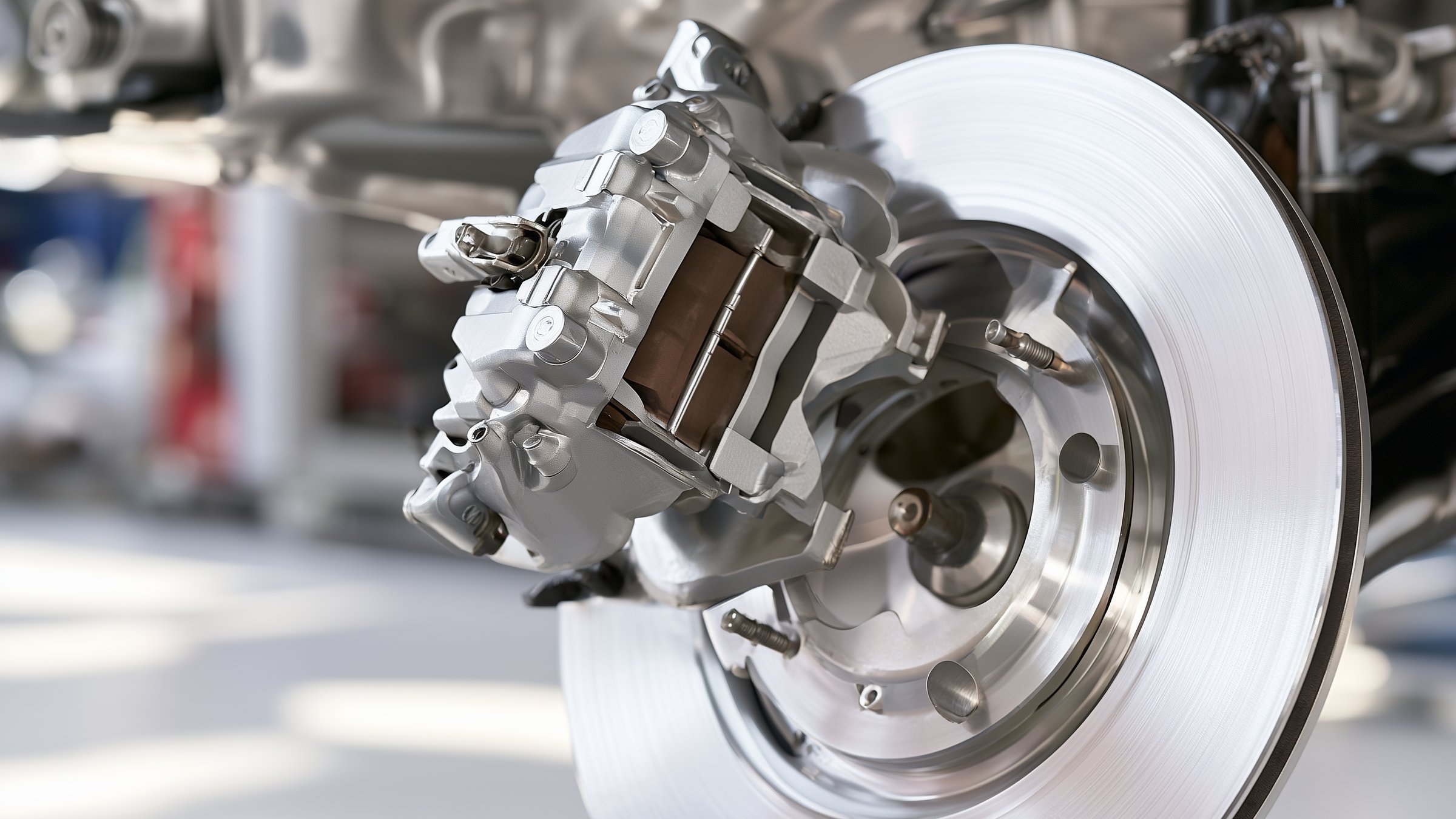
You can see the front pads on most Fords through the wheel, in daylight, in about a minute. It will not replace a measurement, but it tells you whether you are early or late.
- Look through the spokes at the front wheel. You are looking for the brake pad pressed against the shiny disc — a block of dark friction material sitting on a steel backing plate.
- Judge the friction material, not the whole pad. The steel plate never wears. What matters is the dark block on it. New, that is around ten to twelve millimeters. Ford’s own trigger is three millimeters — below that, Motorcraft pads are replaced under the Lifetime Brake Pad Guarantee.
- Three millimeters is about the thickness of two stacked pennies. If what you can see is thinner than that, it is not a next-month job.
- Look at the disc face too. A smooth surface with a light polish is normal. Deep scoring you can catch a fingernail in means something has been grinding.
- If you cannot see anything useful, that is normal. Solid wheels, small gaps and rear drum brakes all hide the answer, and rear pads on many late-model vehicles wear faster than owners expect. That is what the wheels-off inspection is for.
Every tire rotation is a wheels-off look at the pads, because the wheels are off anyway. That is the single cheapest way to catch brakes at the squeal stage rather than the grinding stage — see tires for what a rotation costs and how often it is due.
Brake offersThe Lifetime Brake Pad Guarantee is a Ford program rather than a monthly discount, and its conditions are worth reading before the job rather than after:See the brake coupon
How much does a brake job cost?
Search that and you get forum threads and an estimator for a 2007 Buick. Here is the part that actually changes the number, and it is Ford’s program rather than our offer: on Motorcraft pads, the pads themselves are free for as long as you own the vehicle.
$0
for the pads, for life
Ford’s Lifetime Brake Pad Guarantee replaces worn Motorcraft pads for as long as you own the vehicle. Pads only — read the next paragraph before you plan around it.
3 mm
is the trigger
Ford’s wording: “if your Motorcraft brake pads wear down to less than three millimeters, we can replace them for as long as you own your vehicle.”
Quoted
labor, per axle
What the work costs here, front or rear. Call (847) 669-6060 for today’s price.
The guarantee, and the four things it does not cover
- Labor is excluded. Ford’s terms say so plainly — “covers pads only; labor costs excluded.” The parts are free; installing them is not.
- Rotor work is not covered, and it is often the bigger half of the bill. The guarantee “requires completion of any necessary brake service (e.g., rotor service)” — which is exactly why the grinding stage costs so much more than the squeal stage.
- The pads must have been Motorcraft, installed by a Ford, Lincoln or Quick Lane technician, and you need the original repair order. It is nontransferable, so it follows you rather than the vehicle.
- Commercial use is excluded — delivery, taxi, limousine, postal, police, tow, racing and emergency vehicles.
The guarantee only exists on Motorcraft pads installed by a Ford, Lincoln or Quick Lane technician. Have the first set installed somewhere else to save on that job and every later set is a full-price job. It is one of the few cases where the dealer price and the cheap price are the same number over the life of the car.
How long do brake pads last?
There is no mileage figure, and anyone who gives you one is guessing. Ford’s own answer is that “depending on your driving habits, operating conditions and vehicle type, your service intervals can vary” — which sounds evasive until you see what actually moves the number.
- Stop-and-go against highway miles. The single biggest factor, and it is not close. Pads only wear when you brake, so a commute down Randall Road uses them several times faster than the same mileage on I-90.
- Towing and payload. More weight to stop means more heat in the system, and heat is what turns even wear into warped rotors.
- Front against rear. Fronts do most of the stopping and usually go first — but rear pads on many late-model Fords wear faster than owners expect, because electronic brake-force distribution and the parking brake both work them.
- How you drive downhill. Riding the pedal down a long grade puts sustained heat through the pads. Engine braking does the same job for nothing.
- Winter salt. Corrosion on the rotor face and around the caliper hardware. Rinsing the wheels when you wash the car genuinely helps.
Two identical Explorers bought the same week can be 20,000 miles apart on pad life. The number that matters is the one measured at the wheel, and it is measured free every time the wheels come off for a rotation — see oil change, where the rotation is inside the package.
What a brake inspection actually covers
Ford’s published scope is “brake friction material, caliper operation, rotors, drums, hoses, and connections,” plus “inspect parking brake for damage and proper operation.” In the bay that comes out as a list.
- Checking for even wear and measuring brake pad and shoe thickness
- Ensuring brake lines and the master and wheel cylinders are not leaking
- Checking rotors for hot spots and run-out
- Inspecting calipers for wear, fluid leaks and movement
- Checking anti-lock brake sensors
- Testing hardware and making the necessary adjustments
- Checking the parking brake for damage and correct operation
The findings, in three piles: what is urgent, what can wait, and what is fine. Uneven wear across an axle is worth naming out loud when you hear it — that is usually a caliper rather than the pads, and replacing pads without fixing it just wears the new ones the same way.
Brake questions we are asked
My brakes grind only in the morning. Do I need new brakes?
Probably not. First-stops-only grinding that clears within a block is overnight surface rust on the rotors — standard for anything parked outside through humid nights and salted winters. If it is still there after the first mile, or the vehicle sat for weeks, the rust may have pitted deeper than the pads can polish off and it is worth an inspection.
How long does it take to replace brake pads?
On a normal job you can usually wait for it. It takes longer when the rotors need machining or replacing, which is the common reason a quoted time moves — ask us to confirm once the wheels are off rather than before. Call (847) 669-6060 and we will tell you what the lane looks like today.
Should I replace all four brake pads at once?
Not necessarily, but always both wheels on the same axle. Fronts and rears wear at different rates and rarely need doing together — the fronts usually go first. Replacing one side only is what causes a car to pull under braking.
Is it cheaper to have brakes done somewhere other than a dealer?
On the first set it can be. Over the life of the car it usually is not, because Ford’s Lifetime Brake Pad Guarantee only exists on Motorcraft pads installed by a Ford, Lincoln or Quick Lane technician — so the second and third sets are free where they would otherwise be full price. It also only applies while you own the vehicle; it is not transferable.
Do you do brakes on non-Ford vehicles?
Yes. Quick Lane works on any make and model. The Lifetime Brake Pad Guarantee is a Ford program on Motorcraft parts, so that part is specific — but the work is not.
Why do my brakes squeak when they are not worn out?
A high steady squeal that goes away when you brake harder is usually the wear indicator, a small metal tab designed to touch the rotor and complain. Squealing that comes and goes with damp weather or a cold morning is often nothing at all. Squealing that has turned into grinding is a different sound and a different answer — see the table above.
My steering wheel shudders when I brake. Is that the pads?
Usually the rotors rather than the pads — warped or unevenly worn, or a caliper hanging up on one side and heating one area of the disc. Hard stops and freeze-thaw potholes both contribute, more so on a truck that tows. It does not settle down on its own; heat makes it worse.
Do rear brakes wear differently?
Yes, and faster than most people expect on late-model vehicles. Electronic brake-force distribution sends more work to the rear than older cars did, and the parking brake works the rear pads as well. Grinding heard only in reverse is often the rear pads announcing themselves.
How do I make brakes last longer in northern Illinois?
Rinse the salt off the wheels when you wash the car, use engine braking instead of riding the pedal down a long grade, and keep the rotations up — the wheels-off inspection that comes with one is the early-warning system that keeps a repair at the pads stage.
Can I keep driving if the brakes are grinding?
If it is constant grinding, only as far as the service center. That sound is metal on metal; it lengthens stopping distances and it is machining the rotors while you drive on it.
Get the noise identified before it changes the bill
Brakes are cheap to maintain and expensive to ignore, and the gap between those two is measured in weeks. Book the Service Department, or drive into Quick Lane on any make without an appointment.
Sources. The Lifetime Brake Pad Guarantee, its three-millimeter trigger and its exclusions are quoted from Ford’s own owner-support pages, read Sept. 10, 2026 — “if your Motorcraft brake pads wear down to less than three millimeters, we can replace them for as long as you own your vehicle,” “covers pads only; labor costs excluded,” and the requirement to complete “any necessary brake service (e.g., rotor service).” The guarantee applies to Motorcraft pads purchased after July 1, 2014, is nontransferable, requires the original repair order and installation by a U.S. Ford Dealer, Lincoln Dealer or Quick Lane technician, and excludes commercial delivery, taxi, limousine, postal, police, tow, racing and emergency vehicles. Ford may change or discontinue the program at any time. The inspection scope and the warning signs are Ford’s wording from the same source; the eight-point inspection list is this dealership’s own. Ford publishes no fixed brake replacement interval — “depending on your driving habits, operating conditions and vehicle type, your service intervals can vary.” Ford, Motorcraft and Quick Lane are registered trademarks of Ford Motor Company.