
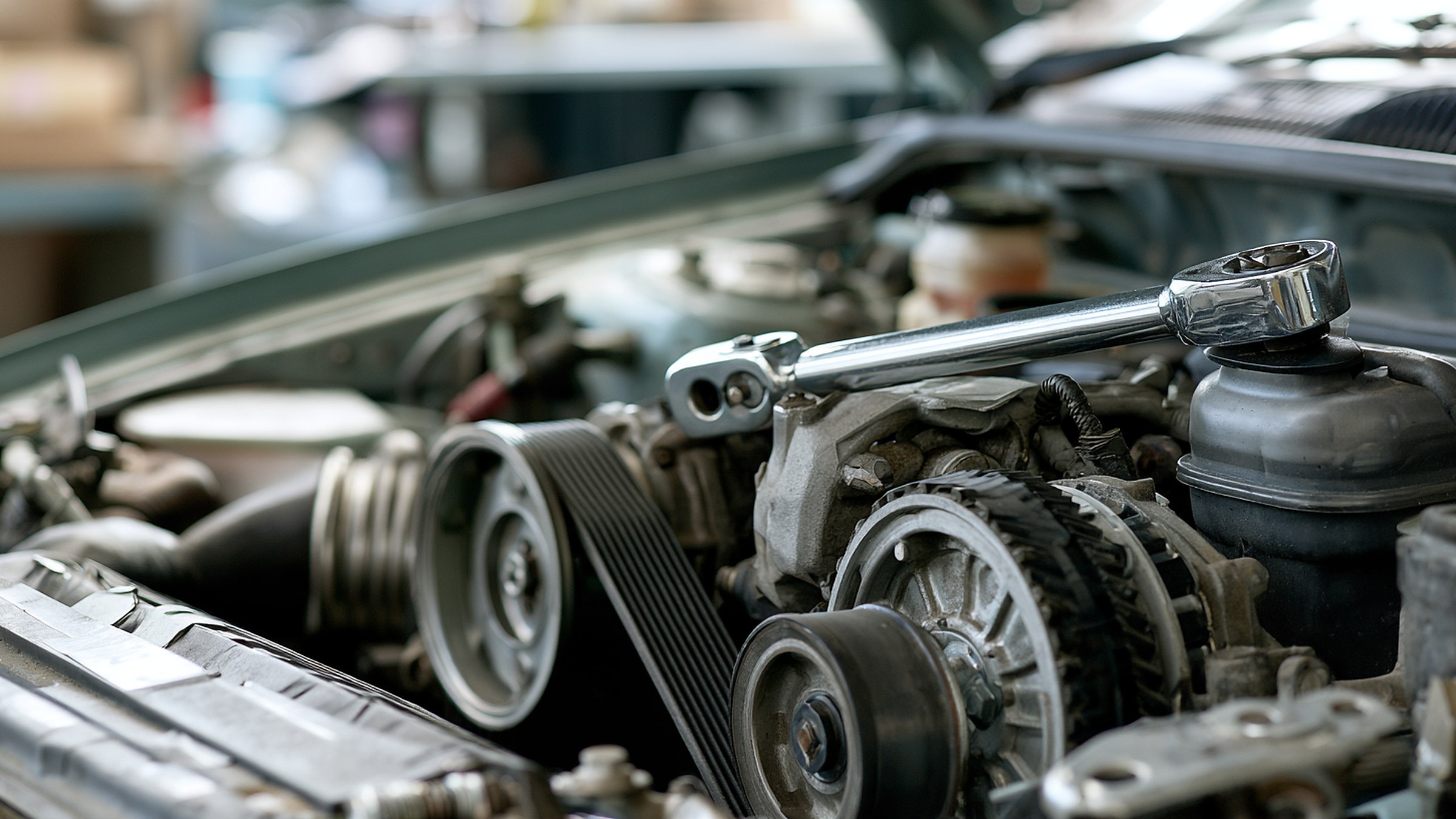
Ford scheduled maintenance in Huntley, IL
Ford publishes two maintenance schedules. Most people assume they are on the first one. Read Ford’s own definition of the second and see whether you still think so.
What is Ford’s maintenance schedule?
It is not a mileage list. On any recent Ford the Intelligent Oil-Life Monitor decides when the oil is due, and almost everything else is pinned to that visit — so the schedule is really one appointment that comes round when the car says so, plus a handful of jobs at fixed mileages.
10,000
miles, or 12 months
Ford’s outer limit between services, whatever the oil monitor says: “do not exceed one year or 10,000 mi between service intervals.”
3,000
miles of leeway
The mileage-based items can be done “within 3,000 mi of the last engine oil and filter change,” which is why they get folded into a service visit rather than booked separately.
3 yrs
for brake fluid, by time
One of the few jobs Ford dates rather than measures — “every 3 years. Do not exceed the designated time for the interval.” Mileage does not enter into it.
What Ford asks for at every service interval
This is the list from the owner manual, not a list we wrote. It is why a service visit takes longer than an oil change.
- Change the engine oil and filter — and reset the oil monitor afterwards, which is the step a quick lube shop most often skips. See oil change.
- Rotate the tires, inspect for wear and measure the tread depth. Not eyeball it — measure it. See tires.
- Perform a multi-point inspection (Ford’s wording: recommended).
- Inspect the automatic transmission fluid level where there is a dipstick to check it with.
- Inspect the brake pads, shoes, rotors, drums, linings, hoses and the parking brake. See brake repair.
- Inspect the engine cooling system strength and hoses. Strength, not just level — the coolant is tested, not looked at.
- Inspect the exhaust system and heat shields.
- Inspect the halfshaft boots, and on four-wheel drive the front axle.
- Inspect the steering linkage, ball joints, suspension, tie-rod ends and driveshaft, and grease anything with a fitting.
- Inspect the wheels and related components for abnormal noise, wear, looseness or drag.
People search for the 30,000- and 60,000-mile service because that is how other manufacturers package it. Ford does not. There is the recurring visit above, and then individual items that fall due at their own mileages — the cabin filter at 20,000, the engine air filter at 30,000, spark plugs and belts around 100,000. If somebody quotes you a flat price for a “60,000-mile service” on a Ford, ask which of those items it actually includes.
Are you on Ford’s normal schedule or the severe one?
Ford publishes two. Everybody assumes the first. Here is Ford’s definition of the second, word for word, and it is worth reading slowly.
“A vehicle that is driven for short trips of less than 5–10 mi, driving in temperatures well below or above average, driving in any dusty conditions, idling more than recommended such as in traffic, and driving with a heavy load or while towing a load are considered severe driving conditions. If the vehicle is driven in any of these conditions, follow the severe service maintenance items listed in the scheduled maintenance chart.”
Now read it as a description of driving in Huntley
- Short trips of less than five to ten miles. The Metra lot, the Prairie Pointe shops, school, the grocery run. If most of your week is inside Huntley, most of your week is on this line.
- Temperatures well below or above average. Northern Illinois manages both, most years, in the same twelve months.
- Idling more than recommended, such as in traffic. Route 47 at five o’clock, or I-90 on a Friday.
- Driving with a heavy load or while towing. This is F-150 and Super Duty country. A boat to the Chain O’Lakes counts.
- Any dusty conditions. The one most people here can honestly skip — until a subdivision goes in next door.
Ford is careful about it, and so are we: “if you operate your vehicle primarily in any of the following conditions, you need to perform extra maintenance. If you operate your vehicle occasionally under any of these conditions, it is not necessary.” One towing weekend a summer does not move you. A five-mile commute, every day, does. If you are not sure which side of that you are on, tell a service advisor how you actually drive — that is a two-minute conversation that changes what your vehicle needs for the rest of its life.
What changes if you are on the severe schedule
| Item | Normal | Severe |
|---|---|---|
| Engine oil and filter | When the monitor says | Every 5,000 mi or 6 months |
| Tire rotation | Every oil change | Every 5,000 mi |
| Engine air filter | Replace at 30,000 mi | Inspect every 15,000 mi |
| Cabin air filter | Replace at 20,000 mi | Inspect frequently |
| Spark plugs | 100,000 mi | 60,000 mi |
| Manual transmission fluid | 150,000 mi | 50,000 mi |
Spark plugs at sixty thousand instead of a hundred thousand sounds like a bill. It is cheaper than the misfire that comes of leaving worn plugs in a turbocharged engine for another forty thousand miles, and far cheaper than the catalytic converter a long misfire can take with it. The severe schedule exists because Ford tested what those conditions do, not because anybody wanted to sell more filters.
How often does transmission fluid and coolant really need changing?
Later than you have been told, on a modern Ford, and the numbers are in the owner manual rather than on a poster in a waiting room.
- Automatic transmission fluid and filter: 150,000 miles. On a current F-150 that is the scheduled change, with the level inspected at every service in between. If somebody is recommending a transmission flush at 60,000 miles on a healthy Ford, ask them to show you where Ford asks for it.
- Engine coolant: 200,000 miles, then every five years or 100,000. Also from the F-150 manual. It varies more than any other item by model — an older Fiesta’s schedule says 100,000 miles then every three years or 50,000 — so this is one to check against your own book rather than a rule of thumb.
- Brake fluid: every three years, by the calendar. Ford dates this one instead of measuring it, and adds that brake fluid servicing “requires special equipment available at your authorized dealer.” Brake fluid absorbs water out of the air, and water lowers its boiling point, which is why the interval ignores mileage entirely.
- Rear axle, front axle and transfer case: not on the normal schedule at all. Ford’s wording is that they “do not require normal scheduled maintenance” and the vehicle “notifies you of required service by displaying a message.” Changing them is “not necessary unless the unit has been submerged in water, shows signs of leakage, a message indicating required service displays.”
- Manual transmission fluid: 50,000 miles on the severe schedule. One of the few places the severe list is dramatically shorter than the normal one.
Ford asks for the axle fluid to be changed any time an axle has been submerged in water — and separately, if an axle overtemp message and the wrench indicator appear together, for the rear axle fluid to be changed at the next convenient time. A flooded underpass in a wet Illinois spring is a real way to meet the first one. It is not on any mileage chart because it is not about mileage.
Maintenance offersA coolant power flush, the oil and filter change, The Works package and the spend-and-save that comes off a whole ticket all carry expiry dates, so they live on one page that removes them the day they end:See the service coupons
When do the cabin and engine air filters need changing?
Two different filters, two different intervals, and only one of them has anything to do with the engine.
- Every 20,000 miles
Cabin air filter
The one you breathe through. It filters the air coming into the vents, not the engine, so a dirty one shows up as weak airflow, a musty smell and windows that take longer to clear — never as a running problem.
- Every 30,000 miles
Engine air filter
The one the engine breathes through. Ford inspects it long before it is due and replaces it early if it needs it, which is the whole point of it being on the inspection list.
- Sooner, if
You are on the severe schedule
Ford: “the life of the engine air filter and cabin air filter is dependent on exposure to dusty and dirty conditions.” On the severe list the engine filter is inspected every 15,000 miles and the cabin filter “inspect frequently, service as required.”
A cabin filter is a cheap part and a quick job, which is why it gets offered so often. It is also genuinely due every 20,000 miles, and in a town with gravel shoulders and a long pollen season it can look grim well before that. The difference between a recommendation and an upsell is being shown the filter that came out. Ask to see it — any shop worth using will already be holding it.
Spark plugs, drive belts and the hundred-thousand-mile jobs
The far end of the schedule is thinly populated and expensive, and it is where the word “tune-up” still gets used for something that stopped existing decades ago.
- Spark plugs: every 100,000 miles on the normal schedule. Sixty thousand if you are on the severe one, or on certain heavy-duty variants. Modern coil-on-plug ignition has no distributor, no points and nothing to time, which is why nobody at a Ford dealer will sell you a tune-up: the plugs are the tune-up, and they come due once or twice in the life of the vehicle.
- Accessory drive belt: inspected at 60,000, replaced at 100,000. Ford then asks for it to be inspected “every other oil change until replaced.” One belt now runs the alternator, the water pump, the power steering and the air conditioning on most engines, so it is a single point of failure that strands you rather than an inconvenience.
- Hoses are inspected, not replaced on a schedule. They are checked for softness, swelling, hardening, cracks, chafing and heat damage. Coolant runs at around two hundred degrees; a hose that lets go takes the engine temperature with it, and an overheated engine can warp a cylinder head, which is the expensive end of a cheap part.
- Timing belts are a small-engine thing. Most Fords sold here use a timing chain that is designed to last the life of the engine — but Ford notes that sustained track use or high rpm can exceed a chain’s service life, and that a wrench indicator will tell you when it has.
- Transmission repair is not maintenance. If the fluid is being changed on schedule and there is still slipping, hunting or a delay engaging drive, that is a diagnosis rather than a service item — and the sooner it is looked at, the more of it is still a repair. Call (847) 669-6060 and describe what it does.
Ford’s own guidance is a symptom rather than an interval: “if you notice that your vehicle pulls to one side while you’re driving, it may be a sign that you need an alignment.” The other tell is tread wearing faster on one edge than the other, which is why the tread depth gets measured at every rotation rather than glanced at. Potholes and curbed wheels do this, and northern Illinois supplies both. See tires.
The maintenance that costs nothing
Ford publishes a monthly list, and every item on it is something you can do on your own driveway in five minutes.
- All the lights, inside and out. Ford’s first item. Walk round it with the lights on, then have someone press the brake pedal. A burnt-out bulb is the cheapest thing on this page and the easiest way to meet a police officer.
- Tires: wear and tear. Look for uneven wear across the tread, cuts in the sidewall and anything embedded. Pressure gets checked cold, at least monthly — see tires.
- Engine oil level. On level ground, engine off, dipstick wiped and re-dipped. A car that uses oil between services is telling you something.
- Windshield washer fluid. Ford’s fourth item, and in a salted winter it is the one that runs out at the worst moment.
- Anything the vehicle tells you. Modern Fords report axle and transfer case service, oil life, tire pressure and battery protection through the cluster display. Those messages are the schedule talking. See batteries for the one message that is not a fault.
Open recalls are free, they are not on any maintenance schedule, and they do not expire. If your vehicle has one outstanding it is worth folding into the next service visit rather than making a separate trip. Check your VIN — it takes about ten seconds.
Maintenance questions we are asked
How much does a transmission fluid change cost?
It depends on the vehicle, and the more useful half of the answer is that on a current F-150 Ford schedules it at 150,000 miles rather than 60,000. The level is inspected at every service in between. If you are being quoted a flush well before that on a vehicle with no symptoms, ask which line of the maintenance schedule it comes from. Call (847) 669-6060 with your year, model and mileage and we will tell you whether it is due.
How often should I change my transmission fluid?
On Ford’s normal schedule for a current F-150, the automatic transmission fluid and filter are changed at 150,000 miles, with the level inspected at every service. Manual transmission fluid on the severe schedule is 50,000. It does move by model and by transmission, so the honest answer is that we will read your vehicle’s schedule rather than quote you a number from another one.
Do I need a coolant flush?
Not on the mileage most people are told. Ford’s current F-150 schedule puts the first engine coolant change at 200,000 miles, then every five years or 100,000. An older Fiesta’s schedule says 100,000 then every three years or 50,000, which shows how much it moves between models. What is checked at every service is the coolant’s strength and the hoses, and a weak mix in a northern Illinois winter is a real problem regardless of mileage.
What is included in a 30,000-mile or 60,000-mile service?
Ford does not package its schedule that way, which is why the answer differs at every shop that sells one. On a Ford, 30,000 miles is when the engine air filter is replaced and 20,000 is the cabin filter; the recurring inspection list happens at every oil change either way. Ask any shop quoting a mileage package to list the individual items, then check them against your owner manual.
Does my Ford need a tune-up?
Not in the sense the phrase was invented for. There is no distributor, no points and no ignition timing to set. What survives of the old tune-up is the spark plugs, and they are a 100,000-mile item on the normal schedule or 60,000 on the severe one. If the vehicle is running badly, that is a diagnosis rather than a service.
How much does a wheel alignment cost?
Call (847) 669-6060 for today’s price. Alignment is not on Ford’s schedule at all — it is symptom-driven. Ford’s own guidance is that “if you notice that your vehicle pulls to one side while you’re driving, it may be a sign that you need an alignment.” Uneven wear across the tread is the other tell, and it is one of the things measured at every rotation.
Can I get maintenance done at Quick Lane instead?
For most of it, yes, and on any make. Quick Lane takes walk-ins and handles oil, filters, rotations, batteries, wipers and the inspection list. The Service Department is where the longer-interval jobs and anything that needs diagnosis belong. See Quick Lane for its hours, which are not the same as the showroom’s.
Does servicing somewhere other than a Ford dealer void my warranty?
No. You are entitled to have maintenance done wherever you like, and doing so does not void a Ford warranty. What matters is that the scheduled maintenance is actually performed, to Ford’s specification, and that you keep the records — Ford’s own wording is that it “urges you to have all recommended maintenance services performed at the specified intervals and to record all vehicle service.” Keep the receipts wherever you go.
My air conditioning is not cold. Is that maintenance?
No — there is no scheduled air conditioning service on a Ford. A system that has gone warm has usually lost refrigerant, which means it has a leak somewhere, and topping it up without finding the leak buys you one summer. It is a diagnosis. Call (847) 669-6060 and describe when it stopped being cold and whether it blows warm all the time or only at idle.
What does the wrench light on my dashboard mean?
It is not the same as the check engine light. On modern Fords it accompanies specific messages — an axle overtemp warning, or a timing chain that has exceeded its service life under sustained high rpm. Ford asks for the rear axle fluid to be changed at the next convenient time after an axle overtemp message. If a wrench appears with no message you can read, note when it happens and bring it in.
Tell us how you drive, not just how far
Whether you are on Ford’s normal schedule or the severe one changes what your vehicle needs for the rest of its life, and it is a two-minute conversation. Book a service visit, or drive into Quick Lane on any make without an appointment.
Sources. The service interval list, the 10,000-mile and 12-month outer limit, the 3,000-mile leeway on mileage-based items, the three-year brake fluid interval and the note that brake fluid servicing “requires special equipment available at your authorized dealer,” the 20,000-mile cabin filter and 30,000-mile engine air filter, the 100,000-mile spark plugs and accessory drive belt, the 150,000-mile automatic transmission fluid and filter, the 200,000-mile engine coolant and the statement that the axles and transfer case “do not require normal scheduled maintenance” are quoted from the 2023 F-150 Owner’s Manual, read Sept. 10, 2026. The definition of severe driving conditions is Ford’s, from the same manual, quoted in full. The severe-schedule items — oil every 5,000 miles or six months, tires rotated every 5,000, engine air filter inspected every 15,000, cabin filter inspected frequently, spark plugs at 60,000 and manual transmission fluid at 50,000 — and the “primarily” versus “occasionally” distinction are from Ford’s Special Operating Conditions Scheduled Maintenance, read the same day. The older coolant figures are from a 2015 Fiesta Owner’s Manual and are included to show how far the interval moves between models. The monthly checklist and the alignment guidance are Ford’s from its published maintenance guidelines. Intelligent Oil-Life Monitor, Ford, Motorcraft and Quick Lane are trademarks of Ford Motor Company. Confirm your own vehicle’s schedule against its owner manual or Ford’s VIN lookup — intervals vary by model, engine and model year.