
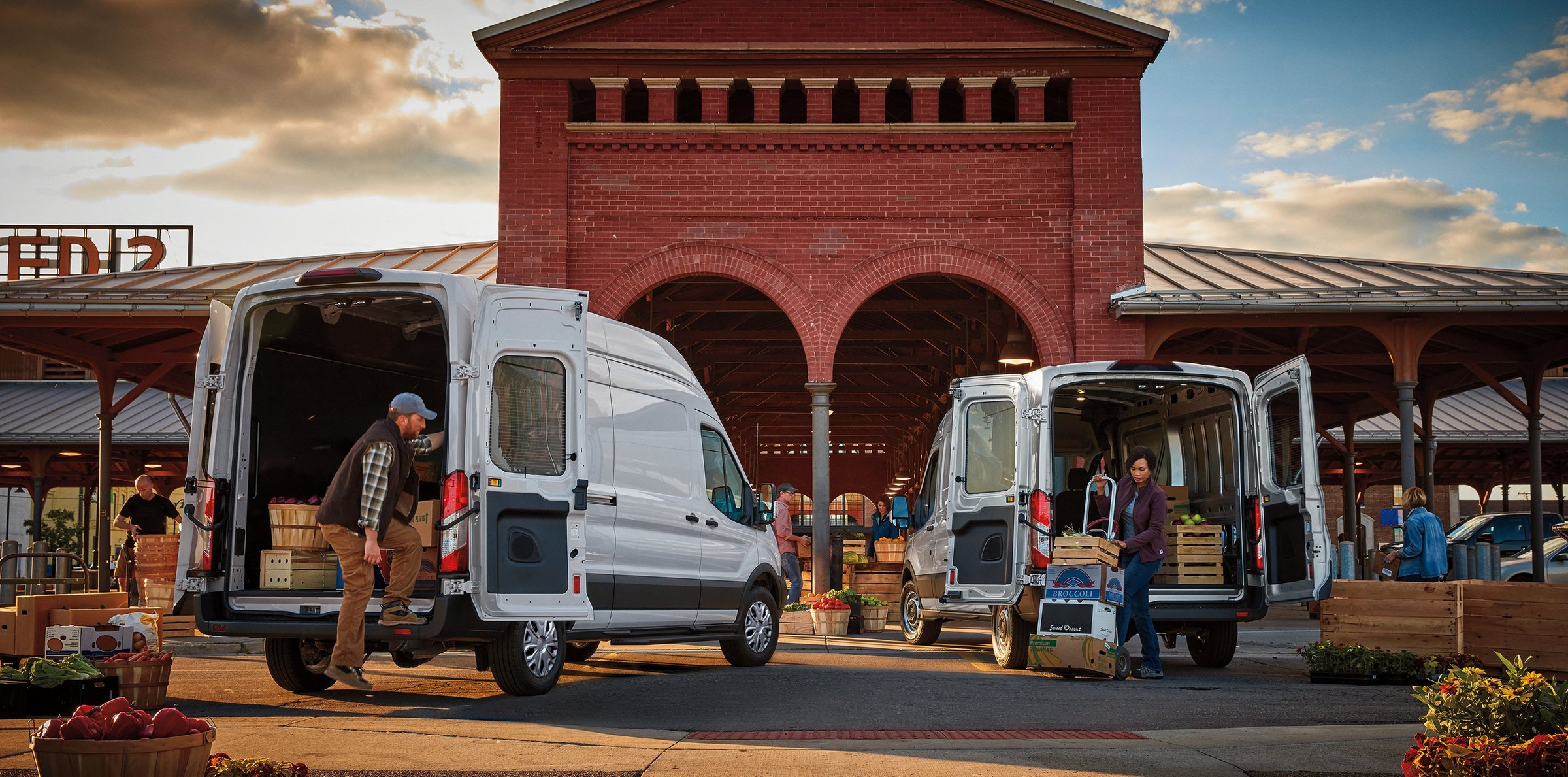
2027 Five body styles · four series · Huntley, IL
The 2027 Ford Transit.Thirty-eight configurations, four decisions.
Ford lists 38 available configurations. Body style, series, roof height and body length are the four choices that produce them — and between them they move payload from 3,342 lb to 5,103 lb and cargo volume from 246.7 to 536.4 cubic feet.
- $48,400
- Cargo Van, plus $2,395 destination
- 5,103 lb
- Maximum payload · 3,342 lb at the other end
- 536.4 cu ft
- Maximum cargo volume · 246.7 at the other end
From $48,400 plus $2,395 destination · Ford’s MSRPs, read Sept. 5, 2026
- Four decisions, not a trim ladderBody style · series · roof height · body length
- Cargo volume more than doubles246.7 cu ft to 536.4 across the range
- Roof height changes the rollover ratingThree NHTSA stars low, one star high — we print it
- No EPA figure existsThe EPA rates no Transit, and we do not invent one
The Transit is not a trim ladder. It is four decisions.
Most model pages walk you up a range from cheap to expensive. That is the wrong shape for this vehicle. Ford builds 38 configurations, and they come from four choices that are largely independent of one another. Get these four right and the rest is upholstery.
1. Body style — what shape the back is
Cargo Van, Passenger Van XL, Passenger Van XLT, Chassis Cab or Cutaway. The first three are finished vehicles you can drive off the lot. The last two are a cab and a frame for an upfitter to build a box, a service body or a shuttle onto. Ford also lists the electric E-Transit alongside them, which has its own page.
2. Series — how much it is rated to carry
T-150, T-250, T-350 and T-350HD. This is the number that decides payload and gross vehicle weight rating, and it is the one most often chosen by habit rather than arithmetic. A T-150 cargo van carries 3,195 to 3,796 lb; a T-350HD with dual rear wheels carries up to 5,103 lb.
3. Roof height — Low, Medium or High
It decides whether you can stand up inside, and it changes the cargo volume by more than a hundred cubic feet. It also changes the NHTSA rollover rating on passenger wagons by two stars, which is in the safety section below.
4. Body length — Regular, Long or Extended
On a 130-inch or 148-inch wheelbase for vans, and 138, 156 or 178 inches for chassis cabs and cutaways. Length is the cheapest cubic feet you can buy: going from Regular to Extended on a high roof adds 240.6 cu ft behind the first row without changing what the van is rated to carry.
Five shapes, and only three of them are finished vehicles
Ford prices the Cargo Van and the two Passenger Vans on its retail pages. Chassis Cabs and Cutaways are quoted, because what they cost depends on what gets built on the back.
-
 $48,400
Cargo Van
Two seats and everything behind them is yours. Three roof heights, three body lengths, and the widest spread of payload in the range. This is the one most trades buy, and the one the Electrician, HVAC and General Contractor trade packages are built for.
- Seats2
- Cargo volume246.7 to 487.3 cu ft behind the first row
- Payload3,195 to 5,103 lb depending on series
- TowingUp to 6,900 lb with the EcoBoost
-
 $59,680
Passenger Van XL
Two, twelve or fifteen seats on a 148-inch wheelbase. The 31-gallon extended-range fuel tank is available here, which matters if the van does long shuttle runs. Read the rollover section before you pick a roof height.
- Seats2, 12 or 15
- Payload2,800 to 3,288 lb — less than any cargo van
- TowingUp to 4,400 lb
- Available31-gallon extended range tank
-
$62,665
Passenger Van XLT
The same van with the driver-assistance package that actually matters on a long shuttle run: Ford Co-Pilot360 Assist 2.0 with Adaptive Cruise Control and a 360-degree camera, standard rather than optional. Three roof heights, two body lengths.
- StandardCo-Pilot360 Assist 2.0 · adaptive cruise · 360-degree camera
- Step up$2,985 over the XL
- Available253-degree rear door opening on high roof
- Seats2, 12 or 15
-
 Quoted
Chassis Cab and Cutaway
A cab and a frame, for an upfitter to build a service body, a box, a shuttle or an ambulance onto. Ford does not publish a retail price because the finished vehicle is not a Ford product alone. Wheelbases of 138, 156 and 178 inches — though Ford deleted the T-350 SRW 156-inch and 178-inch versions of both for 2026.
- Wheelbases138, 156 and 178 inches
- PriceQuoted — depends on the upfit
- Deleted for 2026T-350 SRW 156″ and 178″, RWD and AWD
- Ask usWe will quote the finished vehicle, not the cab

Body styles and their availability are from the 2026 Transit Order Guide, 04/30/26, published by Ford and read Sept. 5, 2026, together with ford.com’s 2027 Transit pages read the same day. Ford has not yet published a 2027 order guide or technical specification; its own 2027 FAQ gives the payload range as 3,342 to 5,103 lb, whose upper figure matches the 2026 specification exactly, and lists one change for 2027, so the 2026 documents describe this vehicle. Starting MSRPs exclude the $2,395 destination and delivery charge, taxes, title, license and the dealer documentary fee.
T-150, T-250, T-350, T-350HD — the number that decides what it carries
Ford’s own payload tables run to more than a hundred rows. Here is what they collapse to. Every figure is a maximum for a properly equipped van; the number that governs yours is on the door-jamb label.
| Series | Gross vehicle weight rating | Maximum payload | What it is for |
|---|---|---|---|
| T-150 | 8,670–8,800 lb | 3,195–3,796 lb | Lighter loads, the most car-like to drive |
| T-250 | 9,070–9,150 lb | 3,298–4,146 lb | The common middle choice for trades |
| T-350 | 9,500 lb | 3,670–4,496 lb | Heavier or denser loads |
| T-350HD dual rear wheel | 9,950–11,000 lb | 3,884–5,103 lb | The heaviest, and the only way past 4,500 lb |
| Body style | Gross vehicle weight rating | Maximum payload | Seats |
|---|---|---|---|
| Passenger Van XL and XLT | 9,250–10,100 lb | 2,800–3,288 lb | 2, 12 or 15 |
A passenger van carries less than any cargo van
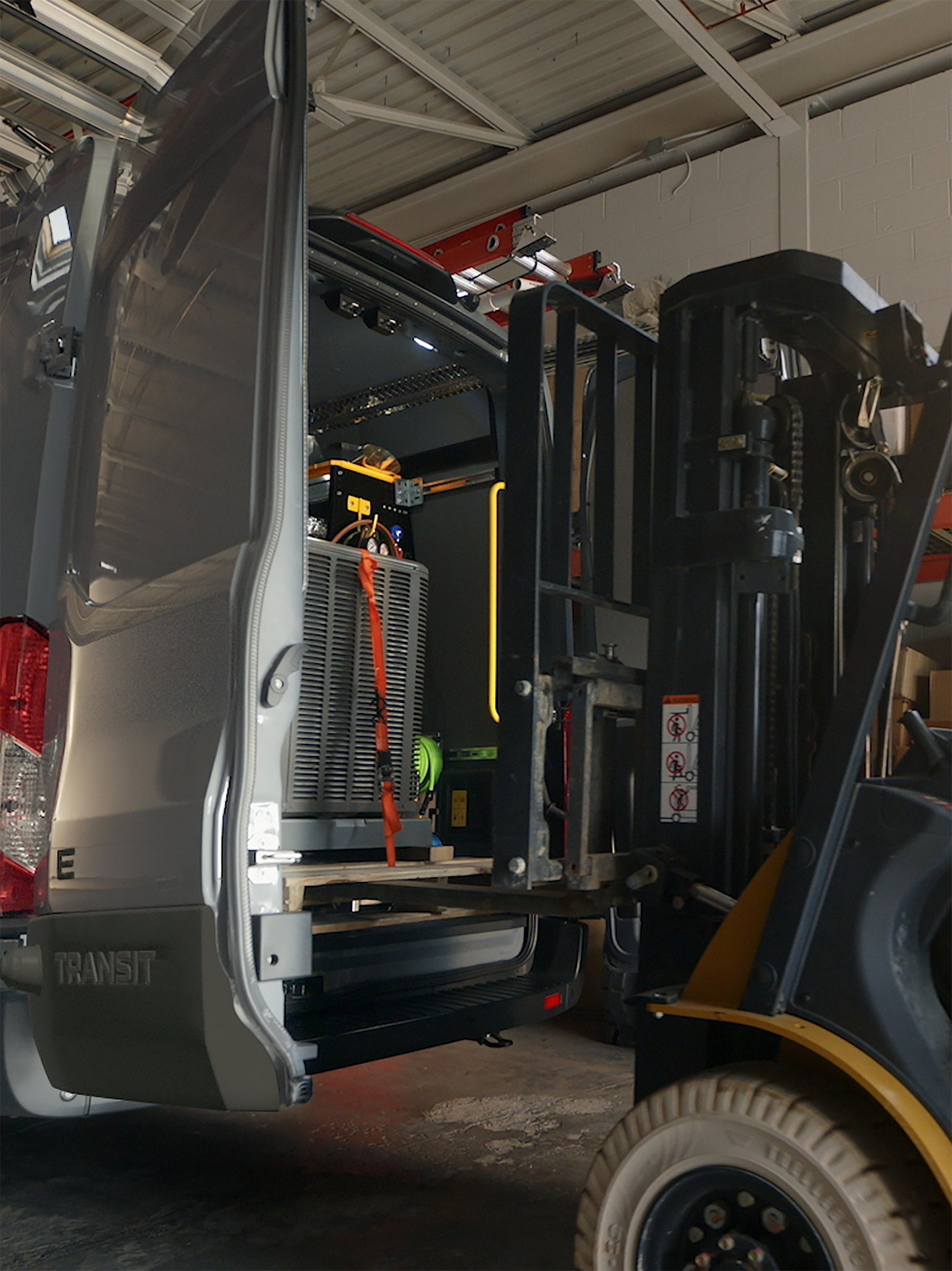
That surprises people, and it is worth understanding before you order. Payload is gross vehicle weight rating minus what the van weighs empty — and twelve or fifteen seats, their mounts and their belts are heavy. A Passenger Van tops out at 3,288 lb, which is below the worst cargo van in the range and barely half of what a T-350HD carries. If the van is carrying people, that is fine: fifteen adults and their bags will not trouble 3,288 lb. If the van is carrying people and equipment — a church group with sound gear, a crew with tools — do the arithmetic before you sign, because it is the payload figure that runs out first. The same logic explains why the numbers inside the cargo-van range move around. Four-wheel drive adds weight and takes it off payload. So does the EcoBoost against the naturally aspirated PFDi: the single highest payload in Ford’s tables is a T-350HD on the EcoBoost at 5,103 lb, but within the same series and configuration the lighter engine generally carries more. The lowest cargo-van figure in the tables is a T-150 EcoBoost, medium roof, Long body, all-wheel drive at 3,195 lb. Ford publishes a Transit Body Decoder that maps every body code to its ratings. If you are ordering rather than buying off the lot, tell us what the van has to carry and we will read the codes back to you before anything is submitted.
Payload and gross vehicle weight ratings from the 2026 Ford Transit Technical Specifications, published by Ford and read Sept. 5, 2026; the ranges above summarize Ford’s full payload tables, which run to more than a hundred configurations. Ford’s own 2027 FAQ gives the overall range as 3,342 to 5,103 lb. Maximum payload varies with accessories and configuration — the figure that governs a specific van is printed on the label in its door jamb, and it is the one that counts. Always properly secure cargo.
- 38Configurations Ford lists as available
- 289.7Cubic feet between the smallest van and the largest
- 1,761Pounds of payload between the lightest series and the heaviest
The cheapest cubic feet you will ever buy
Roof height and body length do not change what the van is rated to carry. They change how much space that weight can occupy — and on a van full of ductwork or parcels, space runs out long before weight does.
| Body length and roof | Behind the first row | With the passenger seat removed | Difference from the smallest |
|---|---|---|---|
| Regular, low roof | 246.7 cu ft | 280.9 cu ft | — |
| Long, low roof | 277.7 cu ft | 311.9 cu ft | 31.0 cu ft more |
| Long, medium roof | 357.1 cu ft | 400.5 cu ft | 110.4 cu ft more |
| Long, high roof | 404.3 cu ft | 453.4 cu ft | 157.6 cu ft more |
| Extended, high roof | 487.3 cu ft | 536.4 cu ft | 240.6 cu ft more |
Can you stand up in it, and will it fit where it lives?
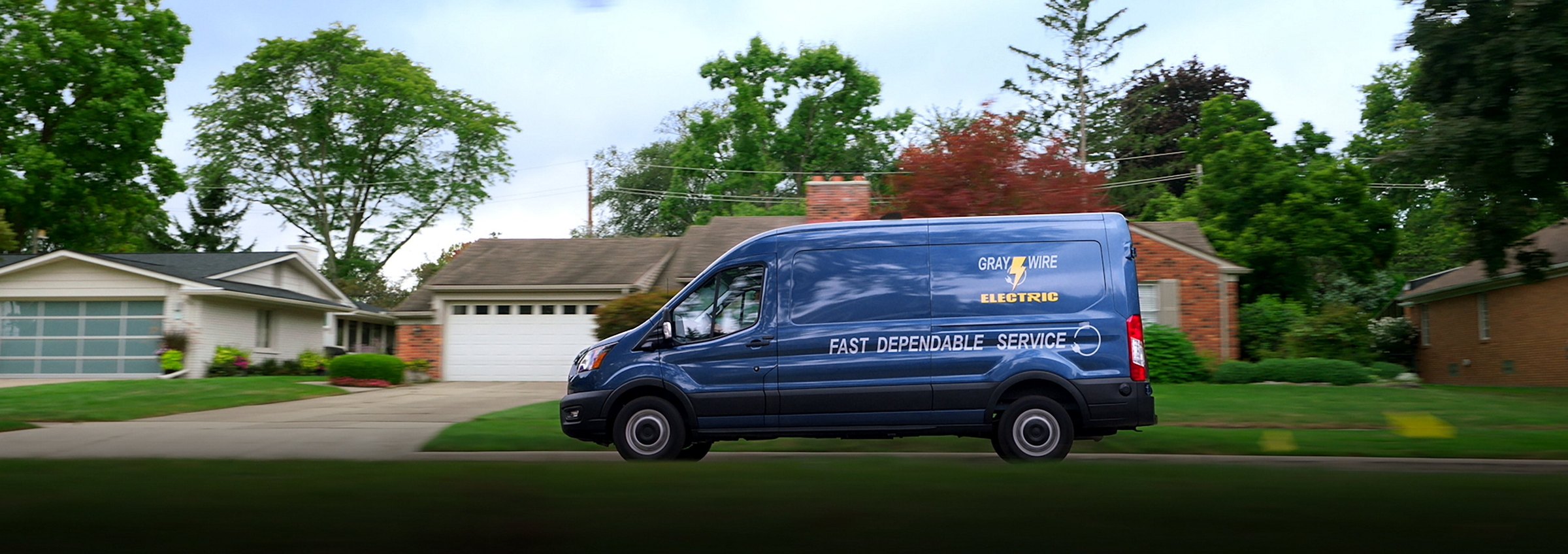
Those are the two questions, and they pull against each other. A high roof lets most people stand upright inside, which changes the job from crawling to walking and is the single biggest quality-of-life difference in the range. It is why plumbers, electricians and parcel fleets buy them. An extended-length high roof gives you 487.3 cubic feet behind the first row, nearly double the smallest van. The cost is where it lives overnight. A high-roof Transit does not fit in a standard residential garage, it does not fit in most parking structures, and around here that includes a good number of the older commercial units off Route 47. If the van goes home with an employee every night, measure the door before you order, not after. A medium roof is the compromise most people should look at first: 357.1 cubic feet on a long body, enough height to work bent rather than crouched, and a profile that clears more doorways. A low roof is for parcels and parts where nobody works inside the van. And if the van carries passengers rather than cargo, read the safety section before choosing a roof — on the wagons, roof height changes the NHTSA rollover rating by two stars.
Cargo volumes from the 2026 Ford Transit Technical Specifications, read Sept. 5, 2026. Wheelbases are 130 and 148 inches for cargo vans, 148 inches for passenger vans and 138, 156 and 178 inches for chassis cabs and cutaways. Passenger Van cargo volume behind the first row runs 223.5 to 461.9 cu ft depending on length and roof; behind the last row of a fifteen-seat extended high roof it is 100.5 cu ft.
Two gas V6s, rear-wheel drive as standard
Both engines are 3.5 liters and both are aluminum. One is naturally aspirated and cheap to run; the other is turbocharged and does the towing.
| Engine | Power | Torque | What it is for |
|---|---|---|---|
| 3.5L PFDI V6 | 275 hp at 6,250 rpm | 260 lb-ft at 4,000 rpm | Naturally aspirated. The default, and the lighter of the two |
| 3.5L EcoBoost V6 | 300 hp at 5,000 rpm | 400 lb-ft at 2,500 rpm | Twin-turbocharged. 140 lb-ft more, low down, where a loaded van needs it |
| Body style and engine | Wheelbase | Maximum towing, RWD | Maximum towing, AWD |
|---|---|---|---|
| Cargo Van, 3.5L EcoBoost | 130 in | 6,900 lb | 6,700 lb |
| Cargo Van, 3.5L EcoBoost | 148 in | 6,800 lb | 6,600 lb |
| Cargo Van, 3.5L PFDI | 130 in | 5,300 or 6,400 lb | 5,000 or 6,100 lb |
| Cargo Van, 3.5L PFDI | 148 in | 5,299 or 6,300 lb | 5,000 or 6,100 lb |
| Passenger Van, 3.5L EcoBoost | 148 in | 4,400 lb | 4,200 lb |
| Passenger Van, 3.5L PFDI | 148 in | 4,200 or 4,500 lb | 4,000 or 4,300 lb |
The two numbers are the two axle ratios
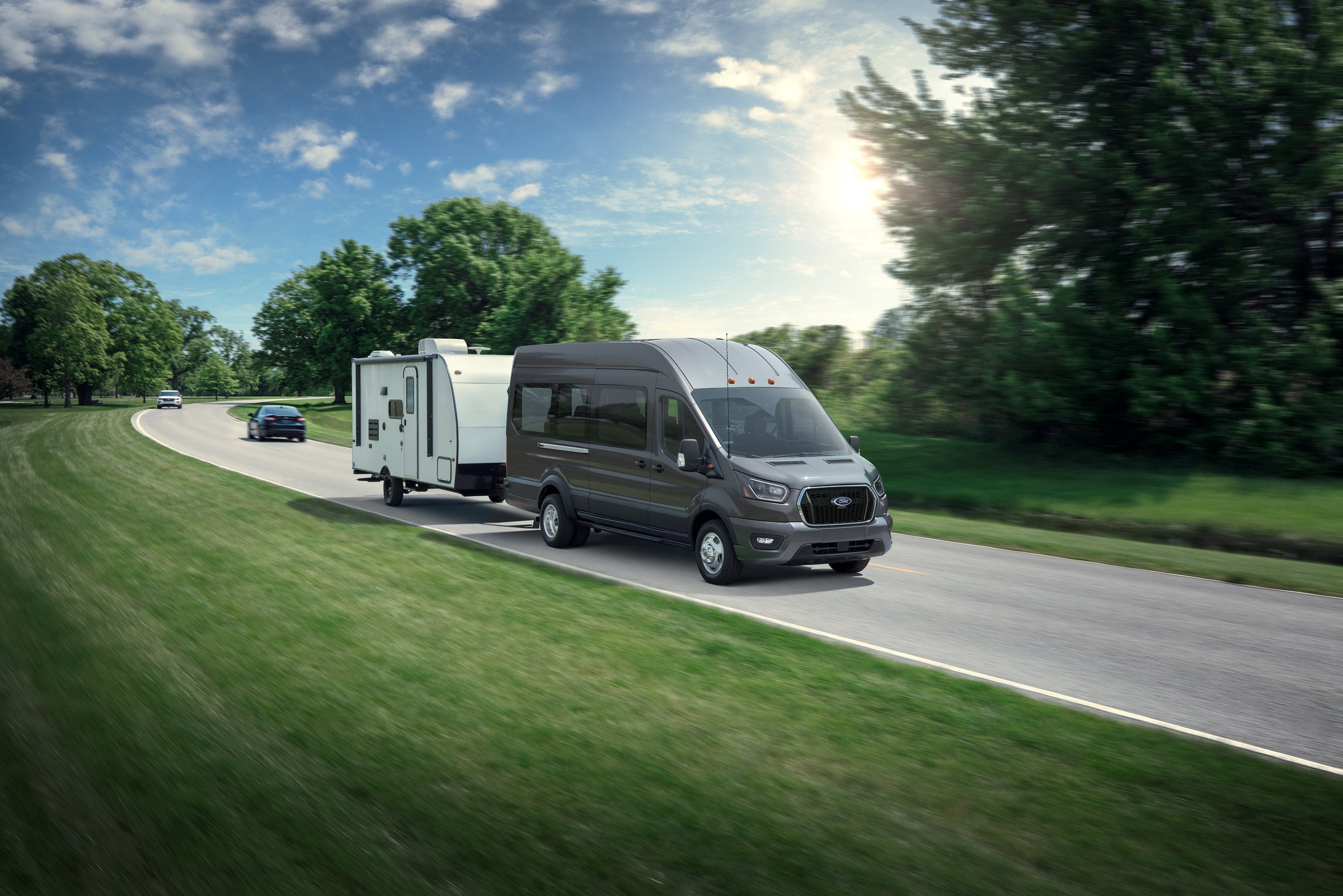
Where a cell shows two figures, they are the 3.73 and the 4.10 axle. The taller ratio is quieter and slightly better on fuel; the shorter one tows more. On the PFDi that is worth 1,100 lb, which is a bigger difference than most option boxes make, and it has to be ordered — you cannot add it later. The EcoBoost is the towing engine and it is not close. It makes 400 lb-ft at 2,500 rpm against the PFDi’s 260 at 4,000, which is exactly the shape of torque a loaded van wants, and it tows 6,900 lb on the short wheelbase against 6,400 for the best PFDi setup. All-wheel drive costs 200 lb of towing throughout. Ford describes the system as integrated so that it does not raise the load floor or the seat height, which is the thing that would otherwise make it a bad trade on a work van, and it comes with selectable drive modes. In Illinois it is worth the money on a van that has to reach sites in February. One limit worth knowing: Ford says not to exceed a 5,000 lb trailer when towing with the bumper only. Above that you need the hitch receiver, and above 5,000 lb you should be talking to us about the trailer brake controller as well.
Engine and towing figures from the 2026 Ford Transit Technical Specifications, read Sept. 5, 2026; Ford has not yet published a 2027 technical specification and lists one change for the 2027 model year. Maximum towing applies to properly equipped base vehicles with required equipment and varies with cargo, configuration, accessories and number of passengers. Paired figures are the 3.73 and 4.10 axle ratios. Ford’s own 2026 documents disagree on fuel: the technical specification lists both engines as running regular unleaded or E85, while the order guide records flex-fuel capability being removed from the 3.5L PFDi for 2026. Both run on regular unleaded — confirm flex-fuel capability on the specific van.
What Ford publishes, and what it does not
Ford retails four of the six body styles online. The other two are quoted, because the price depends on what an upfitter builds onto the back.
| Model | Starting MSRP | With destination | Note |
|---|---|---|---|
| Transit Cargo Van | $48,400 | $50,795 | The base of the range |
| E-Transit Cargo Van | $54,260 | $56,655 | Electric — see its own page |
| Transit Passenger Van XL | $59,680 | $62,075 | 2, 12 or 15 seats |
| Transit Passenger Van XLT | $62,665 | $65,060 | Adaptive cruise and 360-degree camera standard |
| Transit Chassis Cab | Ford publishes none | — | Quoted with the upfit |
| Transit Cutaway | Ford publishes none | — | Quoted with the upfit |
Starting MSRPs are Ford’s own published base prices for the 2027 Transit, read from ford.com in a rendered browser on Sept. 5, 2026, and exclude the $2,395 destination and delivery charge, taxes, title, license and the dealer documentary fee. Ford’s destination and delivery charge is $2,395 for both the Transit and the E-Transit, read from Ford’s published charges the same day. Ford publishes no retail starting MSRP for the Chassis Cab or the Cutaway on any page we can reach, so we have not printed one — the dealership quotes those with the body. Ford can change pricing at any time.
One change for 2027, and $500 on the passenger vans
Ford still publishes the 2026 Transit, and its cards offer Search Inventory rather than Build and Price — the tell that it is remaining stock rather than something you can order. If you are standing next to a leftover 2026, this is the short version.
| Model | 2026 | 2027 | Change |
|---|---|---|---|
| Passenger Van XL | $59,180 | $59,680 | $500 more |
| Passenger Van XLT | $62,165 | $62,665 | $500 more |
What 2027 actually adds
One item, in Ford’s own words: “The Ford Security Package is now available on 2027 Ford Transit Vans. Help protect your investment with theft alerts, remote vehicle lockdown, and recovery services.” That is the entire answer Ford gives to the question of what is new. On a commercial van that is parked overnight with tools in it, it is not a trivial addition — but it is one addition.
2026 was the year that mattered
Ford’s 2026 order guide opens by saying the model year “brings a significant update to standard content, options, and packages when compared to prior model years,” and it did: Ford Co-Pilot360 became standard on every series, SYNC 4 with a 12-inch display became standard on every series, keyless push-button start became standard, and the electrical architecture gained a 5G modem and over-the-air software updates.
So a leftover 2026 is a real option
It is the same vehicle with the same standard equipment, $500 cheaper on a passenger van, without the Security Package. That is a straightforward trade and we will not pretend otherwise. What you cannot do is order one — the 2026 is stock only, so what is on the ground is what exists.
Two things Ford dropped for 2026
The T-350 SRW 156-inch and 178-inch Chassis Cab and Cutaway, in both rear- and all-wheel drive, were deleted. So were SYNC 3, the four-inch displays and two paint colors, Avalanche Gray and Abyss Gray. If you are replacing a van from a fleet bought a few years ago, the exact configuration you had may no longer exist — worth checking before you assume a like-for-like order.
2026 and 2027 starting MSRPs read from ford.com on Sept. 5, 2026, both in a rendered browser; each excludes destination and delivery, taxes, title, license and the dealer documentary fee. The 2026 page publishes only the two Passenger Vans, so no 2026 Cargo Van price was available to compare. Model-year changes are from Ford’s 2027 Transit FAQ and the 2026 Transit Order Guide, 04/30/26, both read the same day. Availability of leftover 2026 vehicles changes daily — call us and we will tell you what is actually on the ground.
Eight colors, two of them fleet only
The same list applies to all five body styles. Two are no cost; the metallics are extra.
| Color | Cost |
|---|---|
| Oxford White | No cost |
| Race Red | No cost |
| Agate Black Metallic | Extra cost |
| Ingot Silver Metallic | Extra cost |
| Carbonized Gray Metallic | Extra cost |
| Blue Metallic | Extra cost |
| School Bus Yellow | Fleet order only |
| Wild Green | Extra cost — fleet order only |
Colors from the 2026 Transit Order Guide, 04/30/26, published by Ford and read Sept. 5, 2026, where all eight are listed as available on the Cargo Van, both Passenger Vans, the Cutaway and the Chassis Cab. Wild Green was new for 2026; Avalanche Gray and Abyss Gray were deleted. Ford does not publish the surcharge for the metallic colors, so we have not invented one — ask us and we will price the specific van. School Bus Yellow and Wild Green are marked fleet only, which means they are not available on a retail order.
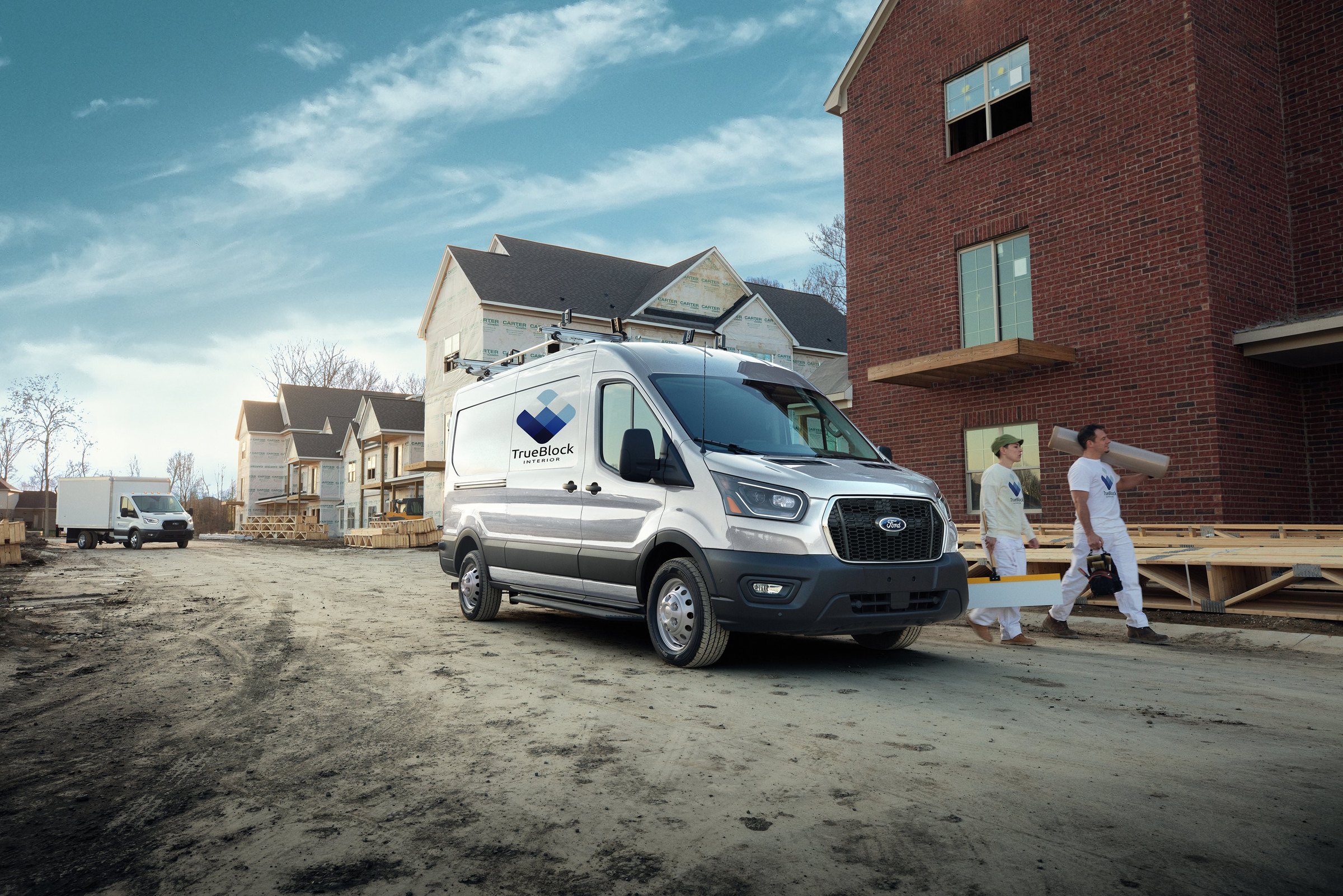
Read this before you choose a roof height
This is the most serious safety section on this site, and it is the one place where a configuration decision has a measurable consequence. Every figure below is NHTSA’s or the IIHS’s own, and we are printing all of it.
Roof height moves the rollover rating two stars
NHTSA rates the 2026 Transit passenger wagon for rollover. A low-roof 12-passenger van with rear-wheel drive rates three stars, with a calculated rollover risk of 26.7 percent. The same van with a high roof rates one star, at 51.6 percent. Nothing else about the vehicle changed. If the van carries people and you have a choice of roof, this is the number to make it on.
The full wagon rollover table
High roof, 12 passenger: one star, 51.6 percent rear-drive and 42.3 percent all-wheel drive. High roof, 15 passenger: one star, 45.1 percent rear-drive; two stars, 35.6 percent all-wheel drive. Medium roof: two stars throughout, 33.8 to 37.6 percent. Low roof 15 passenger: two stars, 33.8 percent. Low roof 12 passenger: three stars, 26.7 percent. All-wheel drive lowers the risk in every pairing.
Side crash is five stars — frontal is not rated
Every passenger wagon NHTSA lists rates five stars for the side crash test. Frontal crash and the overall rating are Not Rated on every configuration, and the cargo vans — gas and electric — are unrated across the board. That is not a poor result; it means the test has not been run. A van that carries fifteen people has no published frontal crash rating, and buyers should know that rather than assume a blank means a pass.
The IIHS does not crash-test the Transit either
It evaluated the 2025 Transit T250 in its commercial-vehicle program, and it says plainly that “crash testing is not performed.” The assessment reviews manufacturer documentation and tests seat belt reminders on a track. Its finding on the Transit: it lacks an effective driver seat belt reminder, alongside the Mercedes Sprinter, the Rivian Delivery 500 and the Chevrolet Express. Pretensioners, force limiters and front and side airbags are standard.
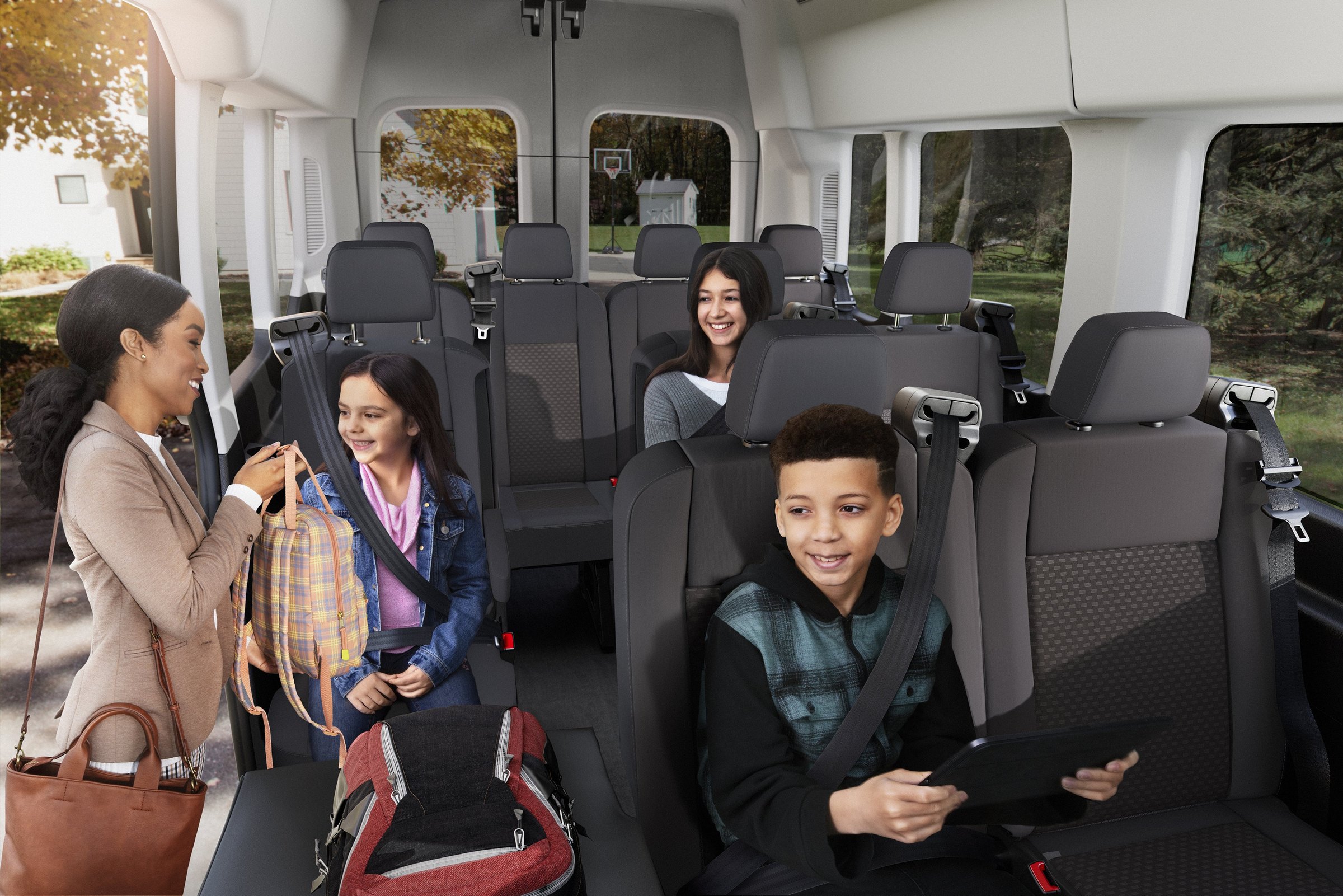
If it carries people, the low roof is the safer order
We are a Ford dealership and we would rather sell you the van you want. We would also rather you knew this before you ordered it, because a fifteen-passenger van is often bought by a church, a school, a care home or a shuttle operator, and the person choosing the roof height is usually thinking about headroom rather than about NHTSA’s rollover calculation. The arithmetic is simple. A tall vehicle has a high center of gravity, and loading the roof or filling the rear seats raises it further. NHTSA’s figure is a calculated risk of rollover in a single-vehicle crash, and on a high-roof twelve-seat Transit that figure is 51.6 percent. On the low roof it is 26.7. All-wheel drive improves every pairing. What that means in practice: order the lowest roof that does the job, seat passengers from the front rows backwards rather than filling the rear first, keep the roof rack empty when the van is full, and make sure whoever drives it knows it handles nothing like a car. NHTSA publishes guidance for fifteen-passenger vans specifically and it is worth ten minutes of any driver’s time. None of this makes the Transit a bad vehicle — it is the best-selling commercial van in the country and its side-impact rating is five stars. It makes the roof height a safety decision as well as a headroom one, and we would rather say so.
NHTSA ratings from the agency’s Safety Ratings API for the 2026 Ford Transit, read Sept. 5, 2026; NHTSA has published no 2027 Transit ratings. Frontal crash and overall ratings are recorded as Not Rated on every Transit configuration, and both the gas and electric cargo vans are unrated entirely. Rollover risk is NHTSA’s calculated percentage, not an observed crash rate. IIHS findings from its commercial-vehicle driver-protection evaluation of the 2025 Ford Transit T250; the IIHS states that crash testing is not performed in that program. Ratings apply to the tested configuration and can change as the agencies publish new results.
The Transit in numbers
Five body styles, four series, three roof heights and three lengths, from Ford’s own documents.
| Specification | 2027 Ford Transit |
|---|---|
| Body | |
| Construction | Steel unibody |
| Body styles | Cargo Van · Passenger Van XL · Passenger Van XLT · Chassis Cab · Cutaway |
| Series | T-150 · T-250 · T-350 · T-350HD, single or dual rear wheel |
| Roof heights | Low · Medium · High |
| Body lengths | Regular · Long · Extended |
| Wheelbases | 130 and 148 in van · 138, 156 and 178 in chassis cab and cutaway |
| Assembly | Kansas City Assembly Plant, Kansas City, Missouri |
| Configurations Ford lists | 38 |
| Seating | |
| Cargo Van | 2 |
| Passenger Van | 2, 12 or 15 |
| Cargo volume, Cargo Van | |
| Regular, low roof | 246.7 cu ft · 280.9 with the passenger seat removed |
| Long, low roof | 277.7 cu ft · 311.9 |
| Long, medium roof | 357.1 cu ft · 400.5 |
| Long, high roof | 404.3 cu ft · 453.4 |
| Extended, high roof | 487.3 cu ft · 536.4 |
| Powertrain | |
| Standard engine | 3.5L PFDI V6, 275 hp at 6,250 rpm, 260 lb-ft at 4,000 rpm |
| Available engine | 3.5L EcoBoost V6, 300 hp at 5,000 rpm, 400 lb-ft at 2,500 rpm |
| Drivelines | Rear-wheel drive standard · Intelligent all-wheel drive available |
| Axle ratios | 3.73 and 4.10 |
| Fuel tank | 25 gal · 31 gal extended range available |
| Recommended fuel | Regular unleaded |
| Capability | |
| Maximum payload | 3,342 to 5,103 lb, by configuration |
| Gross vehicle weight rating | 8,670 to 11,000 lb, by series |
| Maximum towing, Cargo Van | 6,900 lb with the EcoBoost |
| Maximum towing, Passenger Van | 4,400 lb |
| Bumper-only towing limit | 5,000 lb |
| Standard driver aids, every series | |
| Ford Co-Pilot360 | Auto high-beam headlamps · Evasive Steering Assist · Lane-Keeping System · Intersection Assist · Pre-Collision Assist with Automatic Emergency Braking and pedestrian detection |
| Passenger Van XLT adds | Co-Pilot360 Assist 2.0 with Adaptive Cruise Control and a 360-degree camera |
| Display | SYNC 4 with a 12-inch center display, standard on all series |
| Economy | |
| EPA rating | None published — the EPA rates no Transit |
| Price | |
| Starting MSRP | $48,400 Cargo Van to $62,665 Passenger Van XLT |
| Destination and delivery | $2,395 |
| Safety ratings | |
| NHTSA, 2026 passenger wagon | Side crash 5 stars · frontal and overall Not Rated · rollover 1 to 3 stars by roof height |
| NHTSA, 2026 cargo van | Not rated |
| IIHS | No crash test · commercial evaluation of the 2025 T250 found no effective driver seat belt reminder |
Specifications from the 2026 Ford Transit Technical Specifications and the 2026 Transit Order Guide, 04/30/26, both published by Ford, together with ford.com’s 2027 Transit pages and Ford’s published destination and delivery charges — all read Sept. 5, 2026. Ford has not yet published 2027 technical specifications or a 2027 order guide; its own 2027 FAQ gives the payload range as 3,342 to 5,103 lb and lists one change for the model year, so the 2026 documents describe this vehicle. Payload and towing maximums apply when the van is properly equipped; the figure that governs a specific van is on its door-jamb label. Ford revises specifications during the model year.
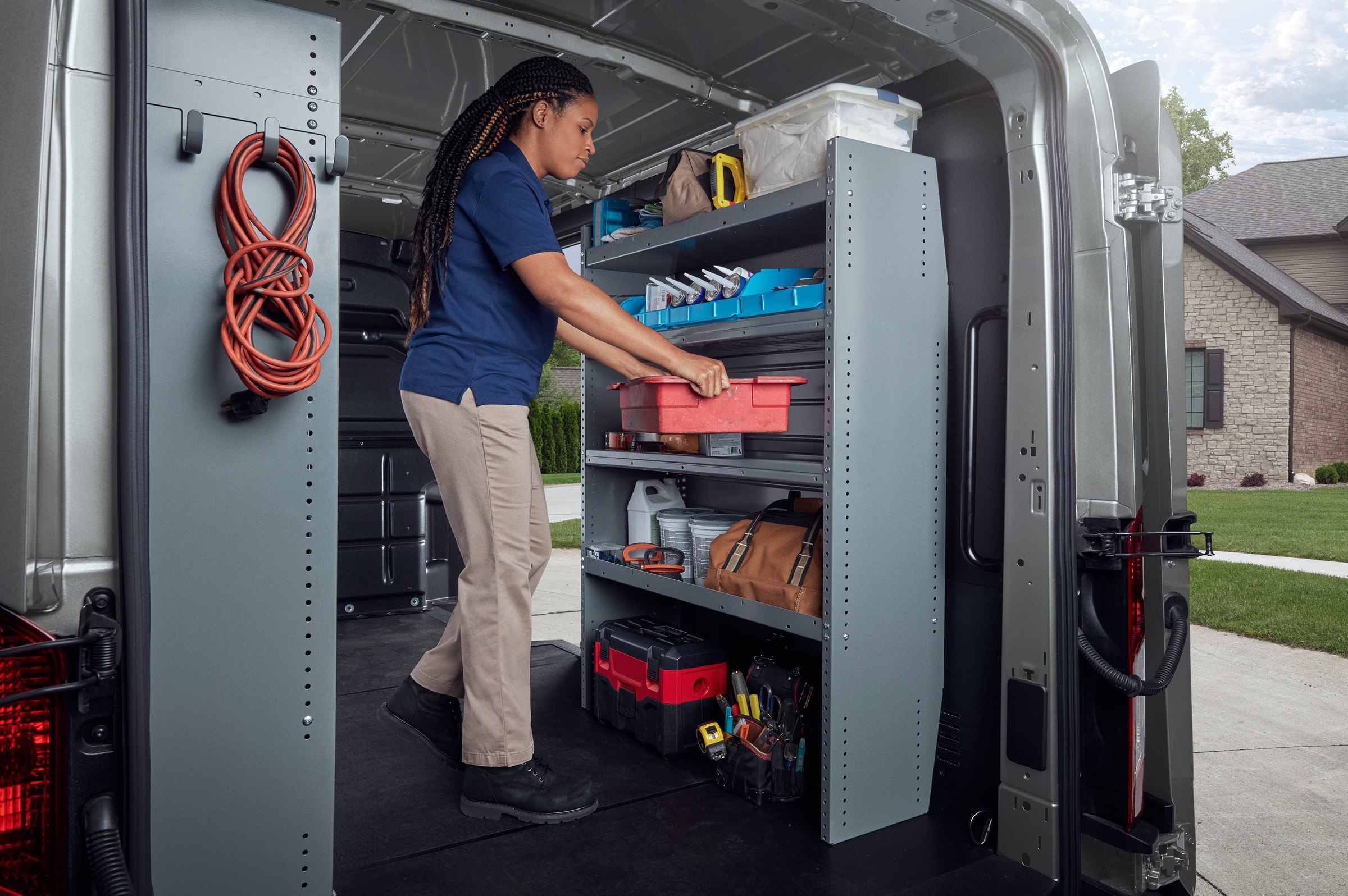
Where it lives overnight is the question nobody asks first
Most of the Transits we sell in Huntley go to trades working McHenry and Kane counties, and the pattern is consistent enough to be worth writing down. The high roof is the right answer for anyone who works inside the van — plumbers, electricians, HVAC — and the wrong answer if it goes home with an employee to a subdivision with a standard garage. A high-roof Transit will not go in one, and it will not clear a good number of the older commercial unit doors off Route 47 either. Measure first. The medium roof clears more doorways and still lets you work without crawling. Winter is the other one. Rear-wheel drive with an empty cargo bay is the worst combination Illinois can hand you, because the weight is all over the front axle and there is nothing over the driven wheels. All-wheel drive costs 200 lb of towing and some payload, and Ford has engineered it not to raise the load floor, which is the thing that would otherwise make it a bad trade. On a van that has to reach a site in February, it is money well spent — and it lowers the rollover risk on every passenger configuration NHTSA rates. Ford’s trade packages are worth asking about before you pay an upfitter separately: Electrician, HVAC and General Contractor packages are offered from the factory and, since 2026, in the extended-long configurations too. We are at 13900 Automall Drive in Huntley, just off Route 47 at I-90, an easy run from Algonquin, Lake in the Hills, Crystal Lake, Elgin and Woodstock.
Four reasons to buy something else
Every number below is Ford’s, NHTSA’s or the IIHS’s, not our opinion.
There is no published fuel economy figure
The EPA rates no Ford van. fueleconomy.gov’s 2026 Ford list runs from the Bronco to the Ranger and contains no Transit of any kind, and there is no 2027 Ford data at all yet. That means no window-sticker MPG, no annual fuel cost estimate, and no way for us to give you an honest running-cost number before you drive one. Every other model page on this site quotes the EPA’s figures. This one cannot.
A fifteen-seat van has no frontal crash rating
NHTSA records frontal crash and overall as Not Rated on every Transit configuration, and the cargo vans are unrated entirely. The IIHS does not crash-test it at all. What exists is a five-star side-impact rating on the wagons and a rollover rating that runs from three stars down to one. If a full set of crash ratings is part of how you choose a vehicle, this vehicle does not have one.
If you tow more than 6,900 lb, this is the wrong vehicle
That is the ceiling, on a short-wheelbase cargo van with the EcoBoost. A passenger van tops out at 4,400 lb. A properly equipped F-150 is rated at 13,500 lb and a Ranger at 7,500 lb. If the trailer is the reason you are shopping, weigh it first and work backwards — a van is the wrong tool for heavy towing regardless of how much it holds.
And if you only need the space occasionally
A Transit is a commercial vehicle that drives like one, parks like one and costs like one — $50,795 delivered at the cheapest. If you need to move something bulky a few times a year, renting a van on those days is cheaper than owning one for all of them, and we will tell you that rather than sell you a van you use twice a month.
- You need to tow more than 6,900 lbThe Ranger tows 7,500 lb and the F-150 up to 13,500, properly equipped
- You want the electric oneThe E-Transit is a different vehicle with its own range, charging and payload figures
- The Transit is the right vehicleSee what is on the ground in Huntley, series and roof height listed
What buying here is like









2027 Ford Transit questions, answered with the number first
How much is a 2027 Ford Transit?
Ford’s published starting MSRPs are $48,400 for the Cargo Van, $59,680 for the Passenger Van XL and $62,665 for the Passenger Van XLT. The electric E-Transit Cargo Van starts at $54,260. Ford’s destination and delivery charge is $2,395, which makes a Cargo Van $50,795 before taxes, title, license and the dealer documentary fee. Ford publishes no retail price for the Chassis Cab or the Cutaway — those are quoted with the upfit.
How much can a 2027 Ford Transit carry?
Ford gives the range as 3,342 lb to 5,103 lb depending on configuration. By series, the cargo van runs roughly 3,195–3,796 lb on a T-150, 3,298–4,146 lb on a T-250, 3,670–4,496 lb on a T-350 and 3,884–5,103 lb on a T-350HD with dual rear wheels. A Passenger Van carries 2,800–3,288 lb — less than any cargo van, because the seats are part of the weight. The figure that governs your van is on its door-jamb label.
How much cargo space does a Ford Transit have?
Behind the first row: 246.7 cubic feet on a regular-length low roof, 277.7 on a long low roof, 357.1 on a long medium roof, 404.3 on a long high roof and 487.3 on an extended-length high roof. Remove the front passenger seat and those become 280.9 to 536.4. The biggest van holds nearly twice what the smallest one does, and roof height and body length are what change it — not the series.
What is the difference between a Transit T-150, T-250 and T-350?
Gross vehicle weight rating, and therefore payload. T-150 is 8,670–8,800 lb of GVWR and carries 3,195–3,796 lb; T-250 is 9,070–9,150 lb and carries 3,298–4,146 lb; T-350 is 9,500 lb and carries 3,670–4,496 lb; T-350HD with dual rear wheels runs to 11,000 lb of GVWR and 5,103 lb of payload. They are otherwise the same van — the series does not change the roof, the length or the engine choice.
How many configurations does the Ford Transit come in?
Ford lists 38. They come from four largely independent choices: body style (Cargo Van, Passenger Van XL, Passenger Van XLT, Chassis Cab or Cutaway), series (T-150, T-250, T-350 or T-350HD), roof height (low, medium or high) and body length (regular, long or extended), plus rear- or all-wheel drive and two engines. Ford publishes a Transit Body Decoder that maps every body code to its ratings.
What engines does the 2027 Ford Transit come with?
Two 3.5-liter V6s. The standard 3.5L PFDI makes 275 hp at 6,250 rpm and 260 lb-ft at 4,000 rpm. The available 3.5L EcoBoost is twin-turbocharged and makes 300 hp at 5,000 rpm and 400 lb-ft at 2,500 rpm — the torque arrives far lower down, which is what a loaded van wants. Both are aluminum, both run on regular unleaded, and rear-wheel drive is standard with all-wheel drive available.
How much can a Ford Transit tow?
A cargo van with the EcoBoost tows up to 6,900 lb on the 130-inch wheelbase and 6,800 lb on the 148-inch. With the PFDi it is 5,300 or 6,400 lb depending on the axle ratio. A Passenger Van tops out at 4,400 lb with the EcoBoost. All-wheel drive costs about 200 lb throughout. Ford says not to exceed a 5,000 lb trailer when towing with the bumper only.
What MPG does a Ford Transit get?
There is no published figure. The EPA rates no Ford van — fueleconomy.gov’s 2026 Ford list runs from the Bronco to the Ranger and contains no Transit, and there is no 2027 Ford data yet. That means no window-sticker MPG and no annual fuel cost estimate. We are not going to invent one; ask us and we will tell you what the vans we have sold actually return, which is a different and less precise thing.
Is the Ford Transit safe?
It depends heavily on which one, and the honest answer has real gaps. NHTSA rates the passenger wagons five stars for the side crash test, but records frontal crash and the overall rating as Not Rated on every configuration, and the cargo vans are unrated entirely. Rollover is rated, and it varies with roof height: a low-roof 12-passenger rear-drive van is three stars at 26.7 percent calculated risk, while the high-roof 12-passenger is one star at 51.6 percent. The IIHS does not crash-test the Transit; its commercial evaluation of the 2025 T250 found it lacks an effective driver seat belt reminder.
Does roof height really change the rollover rating?
Yes, by two stars. NHTSA’s 2026 figures for the 12-passenger wagon with rear-wheel drive: low roof three stars and 26.7 percent calculated rollover risk, medium roof two stars and 37.6 percent, high roof one star and 51.6 percent. All-wheel drive lowers the risk in every pairing. If the van carries passengers and you have a choice, order the lowest roof that does the job, and load from the front rows backwards.
What is new on the 2027 Ford Transit?
One thing, in Ford’s own words: the Ford Security Package is now available, with theft alerts, remote vehicle lockdown and recovery services. 2026 was the substantial year — Ford Co-Pilot360 became standard on every series, SYNC 4 with a 12-inch display became standard, keyless push-button start became standard, and the electrical architecture gained a 5G modem with over-the-air updates. The 2027 passenger vans are $500 above the 2026.
What colors does the Ford Transit come in?
Eight, and the same list applies to all five body styles. Oxford White and Race Red are no cost. Agate Black Metallic, Ingot Silver Metallic, Carbonized Gray Metallic and Blue Metallic are extra-cost metallics. School Bus Yellow and Wild Green are fleet order only. Avalanche Gray and Abyss Gray were dropped for 2026. Ford publishes no surcharges, so ask us and we will price the specific van.
Tell us what the van has to do
Call (847) 669-6060 and describe the job — what it carries, how heavy, whether anyone works inside it and where it parks overnight. That is a faster route to the right body code than any configurator, and it is what we are here for.
Come and stand inside a high roof and a medium roof
Two minutes settles a question that a spec sheet cannot, and it is the decision that everything else on this page hangs off. We are on Automall Drive, just off Route 47 at I-90 — an easy run from Algonquin, Lake in the Hills, Crystal Lake, Elgin and Woodstock.