
Ford battery replacement in Huntley, IL
A battery gives you one warning, and most people are asleep when it arrives. Here is how to read it, what a new one actually costs, and the eight hours afterwards nobody mentions.
How do I know if my car battery is dying?
A failing battery is unusually polite about it. It gives you a slow crank on a cold morning, then starts normally for a week, then does not start at all. The trick is noticing the first one.
- A slow crank. Ford’s own list of warning signs starts here — “an audible slow crank when you attempt to start your engine.” It is easiest to hear on the first start of the day, and it is the one people talk themselves out of.
- A lit battery or check engine light. Also on Ford’s list. The battery light is about the charging system rather than the battery itself, which is why a new battery sometimes does not fix it.
- The smell of rotten eggs. Ford lists this too. It is hydrogen sulfide from a battery that is being overcharged or is failing internally, and it means stop guessing and have it tested.
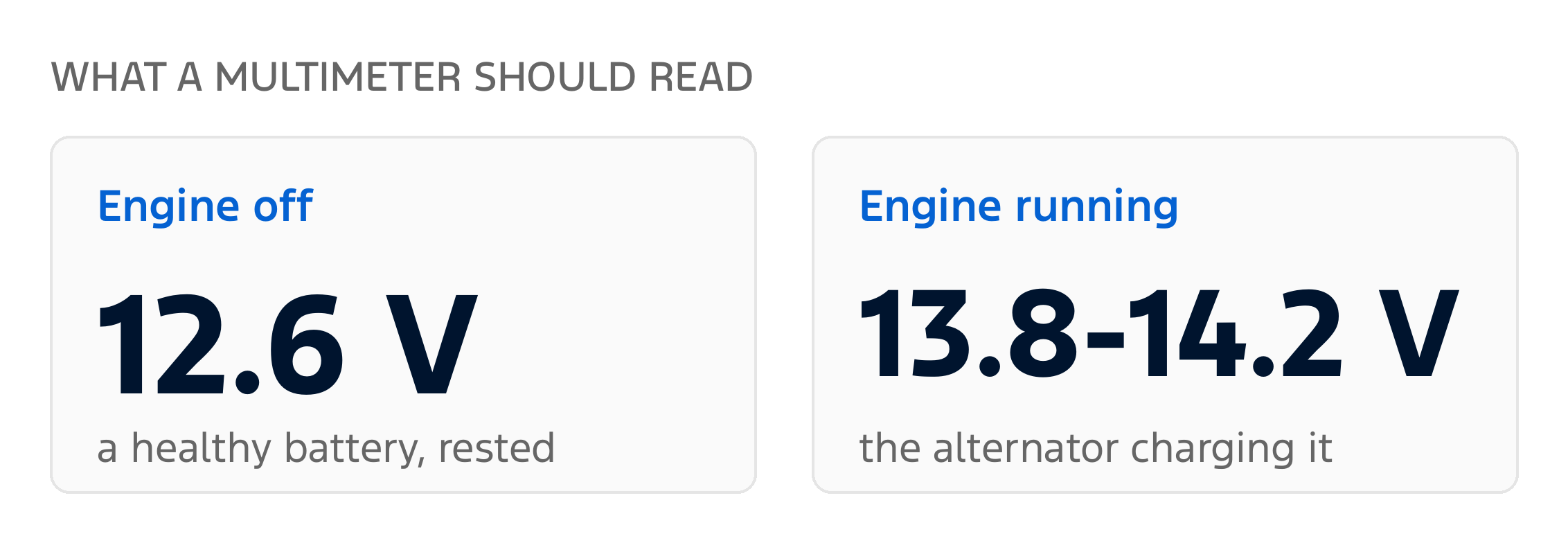
- Around 12.6 volts at rest. AAA’s figure: “with the car off, a healthy battery should read around 12.6 volts. Start the car, and the reading should jump between 13.8 and 14.2 volts.” If it does not jump, the problem is the alternator, not the battery.
- It keeps needing a jump. A battery that has been run completely flat does not fully recover — AAA’s wording is that “allowing any car battery to go completely dead will take a big chunk out of its lifespan.” Two jump starts in a month is a replacement conversation.
If your heated seats, heated steering wheel, climate control, audio or navigation switch themselves off and the display says something about battery protection, that is the Battery Management System doing its job, not a fault. Ford’s owner manual is explicit: the message “is only for notification that an action is taking place, and not intended to indicate an electrical problem or that the battery requires replacement.” It shows up most often after a long spell of short trips, or a week at the airport.
How long does a car battery last?
Three to five years is the honest range, and where you live moves it. AAA puts it plainly: “in cooler northern climates, a battery may last five years or longer, but in hot southern locales, a car battery will typically last approximately three years.” Northern Illinois is the good half of that.
3–5 yrs
is the normal range
This dealership’s own guidance says most will last up to five years, depending on conditions and how often you drive. AAA’s range for the whole country is three to five.
Year 3
is when to start testing
AAA’s recommendation: “once a battery reaches its third year, have it tested annually.” Testing here is free and takes minutes — see below.
No. 1
cause of failure is heat
AAA again: “heat, in fact, is the number one culprit behind battery failure.” The three things that shorten a battery’s life are time, heat and vibration.
Batteries mostly die on the first genuinely cold morning, so everyone blames the cold. The damage was done in the heat — AAA’s research names heat, not cold, as the number one cause of battery failure, and reports being “flooded with requests for roadside assistance” whenever temperatures sit near ninety degrees for several days running. Cold weather does not break the battery. It reveals what August already took. Which is why the useful time to have it tested is the end of summer, not the first frost.
What shortens a battery’s life faster than mileage does
- Short trips. AAA: “batteries in cars driven mostly on short trips may not fully recharge.” A ten-minute run to the Huntley Metra lot and back does not put back what starting the engine took out, and a battery held permanently below full charge ages faster. It is the same driving pattern that shortens an oil change interval, and for the same reason.
- Sitting still. The other half of the same problem. Anything with keyless entry, telematics or an alarm draws a small current around the clock; three weeks in a driveway or an airport lot is enough to matter on a battery already in its fourth year.
- Heat and vibration. The two mechanical killers. Heat evaporates electrolyte and corrodes the plates; vibration shakes the plate material loose, which is why a loose hold-down clamp is a genuine problem rather than a tidiness issue.
- Being run completely flat. Lights left on overnight, or a door not quite shut. Every full discharge takes a measurable piece of the battery’s remaining life, and the damage does not come back when you recharge it.
- A charging system that is not charging. If the alternator is undercharging, the new battery you fit will fail early too. That is what the 13.8–14.2 volt check with the engine running is for.
How much does a Ford battery cost?
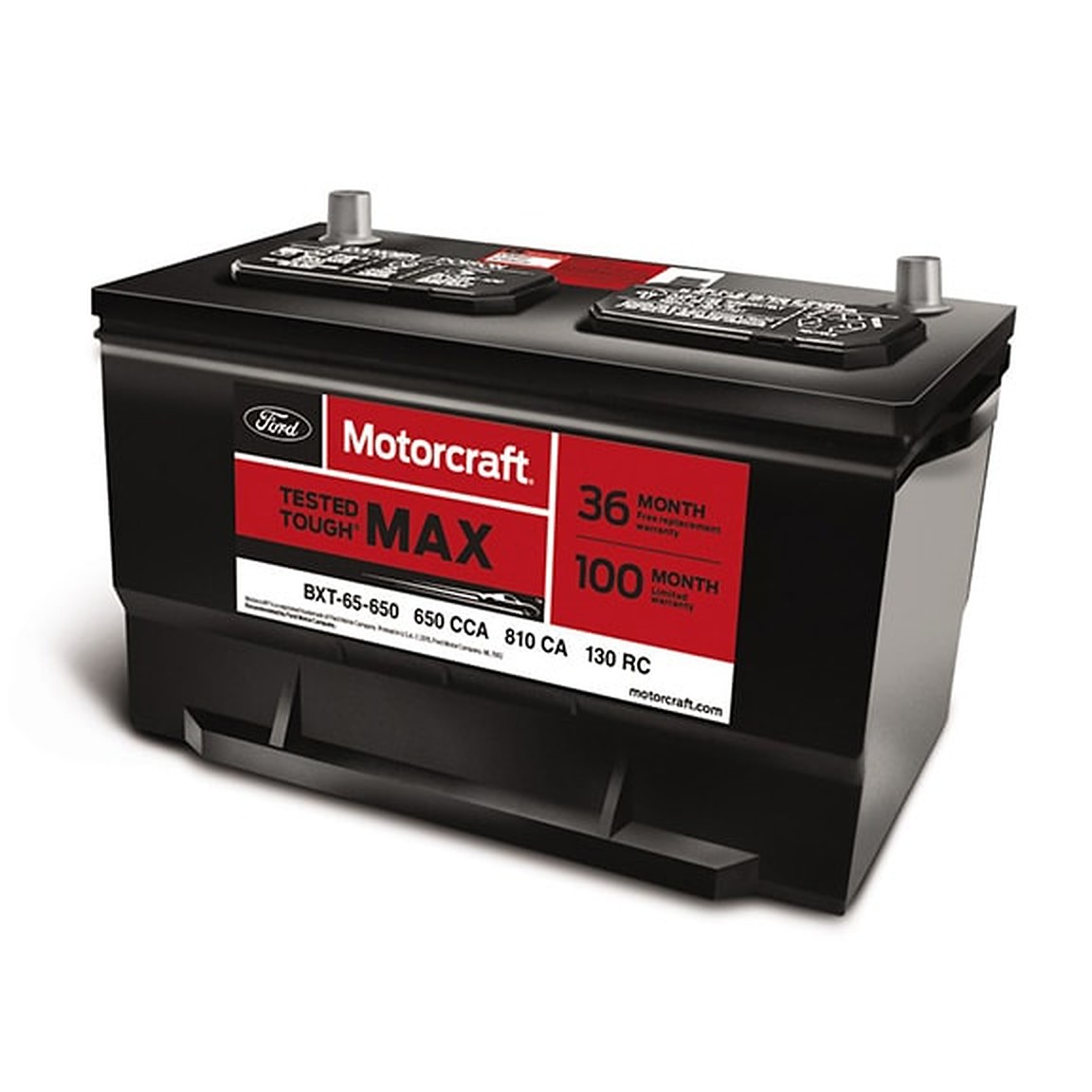
Two Motorcraft lines, about fifty dollars apart. They look the same on the shelf and the difference is not the box — it is how long Ford replaces the battery for nothing if it fails.
Battery pricesFord publishes both Motorcraft prices with their Rewards Points equivalents, and both carry an expiry date — so they live on the coupon page, where they come down the day they end:See the battery coupons
Every published battery price in the industry ends “installation extra” and none of them say extra how much. Call (847) 669-6060 for today’s installation price.
What the extra fifty dollars actually buys
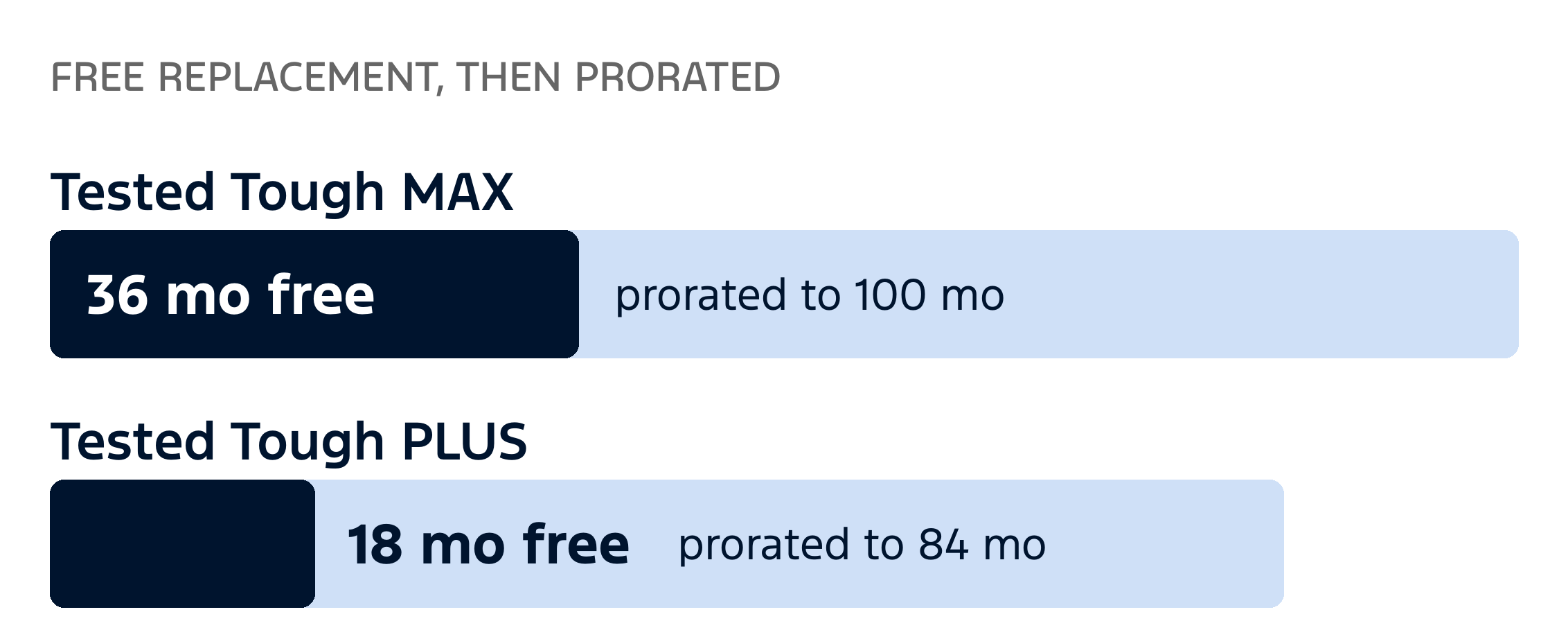
Free replacement means Ford gives you a new battery at no charge if that one fails inside the period. Prorated means you get a credit against a new one that shrinks as the months pass. The MAX costs about fifty dollars more and doubles the free period, which is the whole argument for it on a vehicle you plan to keep. For reference, most other Motorcraft parts carry 24 months and unlimited mileage with labor included — batteries are the exception that is scaled this way. One caveat worth raising at write-up: Ford’s current battery offer advertises a 24-month replacement warranty alongside the PLUS price, and the Motorcraft warranty sheet lists that line at 18 — ask which term applies to the battery going in your vehicle before you choose.
What the price does and does not include
- “With exchange” means you leave the old one. Every published battery price assumes it. Bring the old battery, or the price is not the price — and a battery is not household waste, so leaving it here is the easy way to be rid of it.
- Installation is extra, everywhere. Ford’s terms say “taxes and installation extra,” and so do the parts stores’ once you read them. The difference is what installation includes here — see the next section.
- Towing comes with a dealer-installed battery. Ford’s wording: the warranty “includes complimentary towing on dealer-installed batteries.” Fit the same battery yourself and that part does not exist, which is worth more than it sounds on a battery that fails at 6 a.m. in February.
- Points work instead of money. Both batteries can be taken in Ford Rewards Points instead of cash — the current figures are on the coupon page.
- Offers move every month. These are Ford’s published national figures as of September 2026 and they carry an expiry date. The live ones are on service coupons, and if you are a Ford employee or retiree there are four fifty-dollar service discounts to generate before the end of the year.
What happens after a new battery goes in
Undoing two clamps is the easy part. On anything built in the last decade or so, the vehicle then has to work out what it has been given — and Ford puts a number on how long that takes.
8 hrs
asleep, locked, ignition off
Ford’s wording: after battery replacement the battery management system “requires eight hours of vehicle sleep time to relearn the battery state of charge.” Driving it does not count. It has to sit.
10 mi
to relearn idle and fuel trim
Ford asks for the engine warmed to normal temperature, a minute at idle, then at least ten miles of driving — otherwise “the idle quality of your vehicle may be adversely affected.”
6
systems it can switch off meanwhile
Heated rear window, heated seats, climate control, heated steering wheel, audio and navigation. Ford lists all six. They come back.

Why a self-installed battery can leave a car acting strange for a day
Ford’s owner manual says it outright: “prior to relearning the battery state of charge, the battery management system could temporarily disable some electrical systems.” So a new battery, a rough idle for the first few miles and the heated seats refusing to come on is not a faulty battery, a faulty car or a bad install — it is a vehicle that has not finished counting. It is also a day of wondering that most people would rather skip. The clock and the radio presets need resetting by hand as well.
Do not ground an accessory — a dash camera, a trailer module, an inverter — directly to the battery’s negative post. Ford: that “can cause inaccurate measurements of the battery condition and potential incorrect system operation.” The monitoring system measures current through a sensor on that cable, so anything wired around the sensor is invisible to it, and the vehicle spends the rest of its life charging to a number that is wrong.
The other Ford battery: the one in your key fob
The fob usually fails before the car does, and it fails the same way — intermittently, from further and further away, until it does not work at the far end of a parking lot. A few things are worth knowing, and every one of them is Ford’s own guidance.
- It is a coin-type three-volt lithium cell. Ford’s own wording. Which one your fob takes is in the owner manual under Keys and Remote Control — the shape of the fob decides it, not the model year.
- Changing it does not erase your key. This is the one people get wrong, and it is the reason fobs get driven around dead for months. Ford: “replacing the battery does not erase the programmed key from the vehicle.” No reprogramming, no appointment, no fee.
- Do not clean anything while it is open. Ford: “do not wipe off any grease on the battery terminals or on the back surface of the circuit board.” That grease is there on purpose, and wiping it off is how a working fob becomes an intermittent one.
- If it still will not work, bring every key you own. Ford’s instruction is to “take all your keys to your Ford Dealer,” because programming is done to the set rather than to one fob. Turning up with the spare in a kitchen drawer at home is a second trip.
- The mechanical blade is in the fob. Every Ford fob hides one, and there is a backup slot or a marked spot inside the vehicle that starts it with a dead fob. Worth finding once, in daylight, rather than in a parking lot in January.
If you would rather not pry a fob apart over a kitchen counter, bring it in. The parts department stocks the cells, and swapping one takes about as long as parking. Call (847) 669-6060 first if you want us to check we have the right cell on the shelf for your fob.
Getting a battery tested or replaced in Huntley
There are two shops at 13900 Automall Drive and they do not keep the same hours. For a battery, the walk-in one is usually the right door.
- No appointment
Quick Lane, any make
Walk in, any make and model, and the battery check is part of the free vehicle check-up. If it needs replacing, it is usually done while you wait. See Quick Lane for today’s hours.
- By appointment
The Service Department
For a Ford or Lincoln with more going on than a flat battery — a charging fault, a drain that keeps coming back, a warning light that stays on after a new battery. Book a time.
- We come to you
Mobile Service and Pickup and Delivery
A battery is close to the ideal mobile job, and a car that will not start is the worst one to drive in. See Mobile Service and Pickup and Delivery for what is covered.
Ford’s terms: “visually inspect and test battery using tester.” A tester loads the battery and reports what it can still deliver, which is a different question from what a voltmeter reads at rest — a battery can sit at 12.6 volts and still fail to turn an engine over on a cold morning. One exclusion worth naming: the hybrid high-voltage battery test is not part of it. The check-up the battery test belongs to looks at the tires and the brakes in the same visit, which is the cheapest way to find any of the three early.
Battery questions we are asked
How long does it take to replace a car battery?
On a normal job it is a wait-for-it job rather than a drop-off. Some vehicles take longer because the battery is not where you would expect it — under a seat, behind a wheel liner or under the load floor — and a few need the cooling pack or a trim panel out first. Call (847) 669-6060 with your year and model and we will tell you which kind yours is.
What battery does my Ford take?
It is decided by group size and cold cranking amps, both of which change with the engine and sometimes with the trim, so two of the same model year can take different batteries. Tell us the VIN — or bring the vehicle in — and we will match it exactly rather than guess from the model name. The number on top of the battery you have now is a starting point, not proof, because the last one may have been the wrong fit.
Is my car battery under warranty?
If it is the original battery, that is your vehicle’s warranty rather than a battery warranty, and it depends on age and mileage. If it is a Motorcraft replacement, the free-replacement period is 36 months on a Tested Tough MAX and 18 on a Tested Tough PLUS, with a prorated credit after that to 100 and 84 months. Bring the repair order, or tell us the vehicle and we will look it up.
Why does my car battery keep dying?
A battery that goes flat repeatedly is usually not the battery. The three common causes are a charging system that is undercharging, a parasitic drain — something staying awake after the vehicle sleeps — and a pattern of short trips that never put back what starting takes out. All three are findable, and replacing the battery without finding the cause buys you a few months and the same problem.
My car will not start but the lights work. Is it the battery?
Often, yes. Lights draw a fraction of what a starter motor does, so a battery can run headlights convincingly and still be unable to crank. Rapid clicking when you turn the key is the classic version of it. A dashboard that goes dark when you turn the key points the same way. A single loud clunk and then nothing points at the starter instead.
Should I clean the corrosion off my battery terminals?
White or blue-green powder on a post is worth dealing with, because it adds resistance exactly where you need none. It is also a symptom rather than a cause — persistent corrosion on one post usually means a leaking seal or a battery being overcharged. Come in and let us look at why it is happening; cleaning it repeatedly is treating the smoke.
Do you replace batteries in non-Ford vehicles?
Yes. Quick Lane works on any make and model, and the free battery check is part of its vehicle check-up. Motorcraft batteries fit far more than Fords; the Ford-specific parts are the warranty program and the Ford Rewards points.
Can a battery be recharged instead of replaced?
Sometimes, and it is worth asking rather than assuming. A good battery flattened once — lights left on, a door ajar overnight — will often come back on a proper charge. A battery in its fifth year that has been run flat twice will not. The test tells the two apart, which is the reason to have it tested before buying anything.
Does cold weather kill car batteries?
Cold weather is when they die, not what killed them. AAA’s research names heat as the number one cause of battery failure — the damage accumulates through the summer and the first hard freeze is simply the morning that asks for more than the battery has left. It is why the useful time to have one tested is the end of August, not the middle of January.
What do I do with the old battery?
Leave it with us. Every published battery price assumes an exchange, so bringing the old one in is part of the deal rather than a favor — and a lead-acid battery is not something to put in a bin or leave in a garage.
Have it tested before it decides for you
The test is free, it takes minutes, and after year three it is the only way to know which winter this battery is going to lose. Drive into Quick Lane on any make without an appointment, or book a time.
Sources. Motorcraft battery prices carry Ford’s own expiry dates, so they are published on the service coupons page rather than here, with Ford’s terms in full. The exchange requirement, the Ford Rewards Points alternatives and the complimentary towing on dealer-installed batteries are Ford’s own published offer terms, read Sept. 10, 2026. The free battery check is Ford’s: “visually inspect and test battery using tester. Hybrid battery test excluded.” Warranty periods are from Motorcraft’s published parts warranty: BXT Tested Tough MAX 36 months free replacement and 100 months prorated, BXL Tested Tough PLUS 18 months and 84 months prorated, with most Motorcraft parts at 24 months and unlimited mileage including labor; Ford’s current battery offer advertises a 24-month replacement warranty alongside the PLUS price, so confirm the term at write-up. The eight-hour relearn, the ten-mile idle and fuel trim relearn, the six systems the battery management system can temporarily disable, the statement that its message is “not intended to indicate an electrical problem or that the battery requires replacement” and the warning against grounding accessories to the negative post are quoted from Ford owner manuals, read Sept. 10, 2026. Key fob guidance — a coin-type three-volt lithium cell, that “replacing the battery does not erase the programmed key from the vehicle,” the instruction not to wipe grease from the terminals or circuit board, and to take all your keys to your dealer — is from Ford owner support. Battery life figures, the 12.6-volt resting and 13.8–14.2-volt running readings, and the finding that heat rather than cold is the leading cause of battery failure are from AAA. Ford may change or discontinue any of these programs at any time. Ford, Motorcraft and Quick Lane are registered trademarks of Ford Motor Company.