
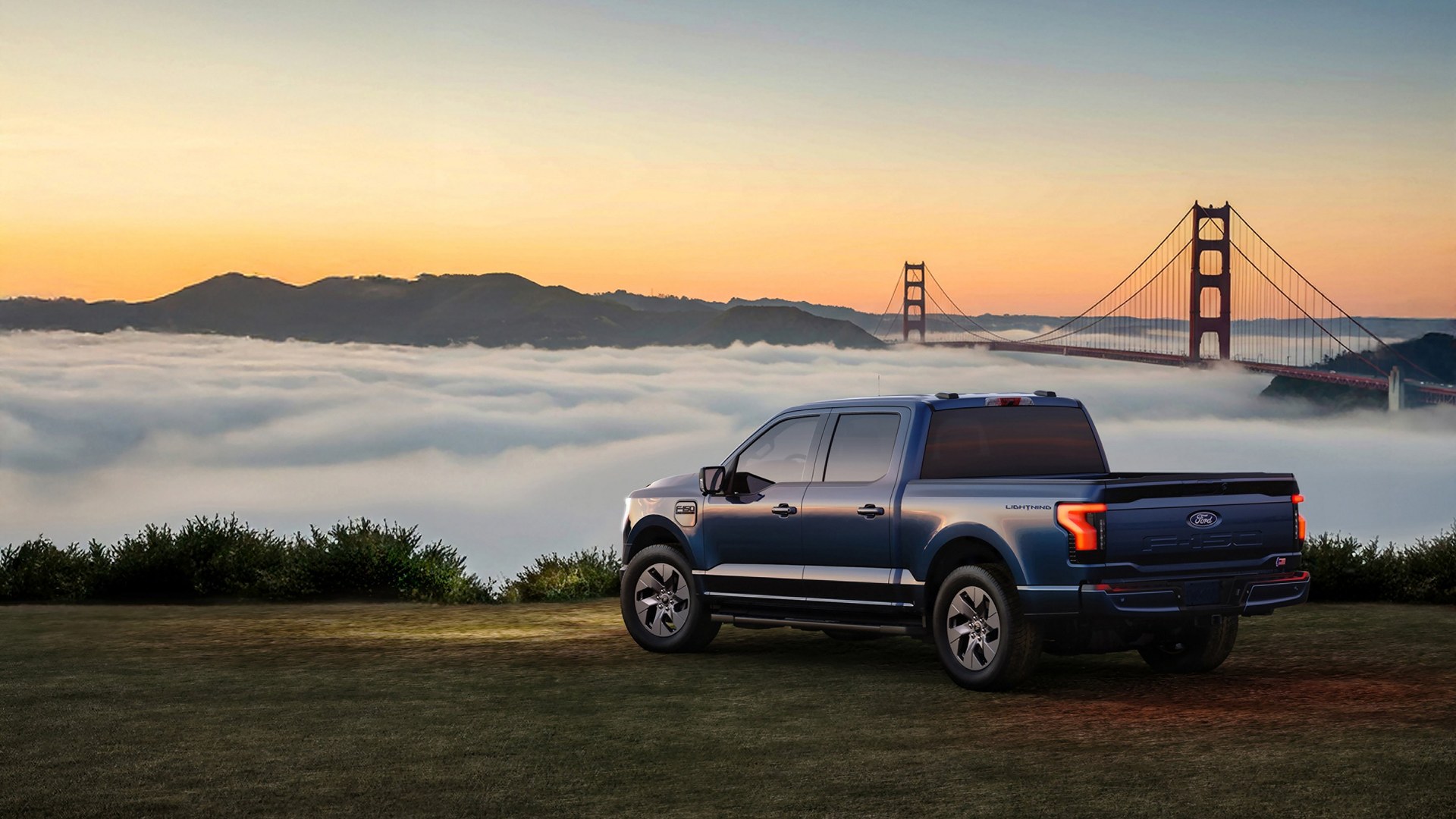
2022-2026 Production ended · Huntley, IL
The Ford F-150 Lightning.You cannot order one. The name is coming back.
Ford ended production of the electric F-150 Lightning in December 2025 and says the next generation will be an extended-range truck with a gas generator. No date, no price, no specifications. Here is what that means if you own one, or are looking at a used one.
- Dec 2025
- Ford: production has concluded
- 8 yr / 100k
- Battery warranty, unchanged
- 13
- Recall campaigns across the run
No new price — production ended December 2025. Used inventory only.
This page carries no price. Ford publishes no MSRP for a model that can no longer be ordered, and what a used Lightning is worth depends on the specific truck – call us and we will price the one in front of you. Range and running-cost figures are the EPA’s own, from its 2025 records, which are the most recent it published. Warranty terms, quotes and the Owner Support summary are Ford’s own words from ford.com, read Sept. 7, 2026.
Ford’s own words, in two places that do not quite agree
There is a lot of secondhand reporting about this truck. These are the primary sources – a Ford press release and Ford’s own website – quoted directly.
The press release, Dec. 15, 2025
Ford wrote: “Ford’s next-generation F-150 Lightning will shift to an extended-range electric vehicle (EREV) architecture and be assembled at the Rouge Electric Vehicle Center in Dearborn, Michigan. Production of the current generation F-150 Lightning has concluded as Ford redeploys employees to Dearborn Truck Plant to support a third crew for F-150 gas and hybrid truck production as a result of the Novelis fires.” So: an aluminum supplier fire moved workers to the gas truck, and the electric one stopped.
ford.com today, under the heading The Evolution of an Era
“The F-150 Lightning redefined what a truck could be. While it’s no longer available in its current form, its impact is helping shape what’s next. Stay tuned for a new wave of Ford EVs built on our groundbreaking Universal Electric Vehicle (UEV) platform.” The page has no configurator, no prices and no specifications left on it – only owner support and a ten-question FAQ.
Which is it – EREV or the UEV platform?
Both statements are current and they point at different things. The press release puts the next Lightning on EREV architecture at the Rouge Electric Vehicle Center. ford.com’s FAQ says the Lightning is being transformed as part of the Universal Electric Vehicle platform, and then describes that platform as the basis for a mid-size electric truck – which the same press release places at Louisville Assembly Plant starting in 2027, a different vehicle at a different plant. We are not going to reconcile Ford’s two statements for it.
When can you buy the next one?
Ford’s answer, verbatim: “While we are not yet prepared to announce specific availability dates, we can assure you our teams are hard at work bringing this innovative vehicle to life.” Doug Field, Ford’s chief EV, digital and design officer, has said the EREV keeps “100% electric power delivery, sub-5-second acceleration” and adds “an estimated 700+ mile range.” That is the whole of what Ford has published. No date, no price, no specification sheet.
There is a 2026 Lightning, and it is the one to want
Ford published a full order guide for the 2026 F-150 Lightning on Nov. 3, 2025 – six weeks before announcing that production had concluded. Almost nobody knows the model year exists, and it has one advantage over every Lightning before it.
Every 2026 has the big battery
Ford’s 2026 order guide lists, under Deleted: the 98 kWh standard-range battery. And under New: the 123 kWh extended-range battery is now standard on Pro, STX and Flash. On a 2022 to 2025 truck the battery is the first thing to check, because the small one is the difference between roughly 240 and roughly 320 EPA miles. On a 2026 there is nothing to check – they all have the long-range pack, and the Platinum gets a 131 kWh.
What else changed for 2026
Three colors in – Argon Blue Metallic, Marsh Gray and Ruby Red Metallic Tinted Clearcoat – and three out: Rapid Red, Space White Tri-Coat and Iconic Silver, which survived on the Pro. Phone as a Key became available on STX and Flash. The NACS fast-charging adapter became a separate option instead of being included with the mobile power cord. USB ports were deleted from the frunk. And BlueCruise moved from standard to optional on the Flash – worth checking on any 2026 Flash you look at.
| Item | What the guide says |
|---|---|
| Series | Pro, STX, Flash, Lariat, Platinum – all SuperCrew, all 4×4, all dual eMotor |
| Battery, Pro / STX / Flash / Lariat | 123 kWh usable capacity, standard |
| Battery, Platinum | 131 kWh usable capacity, standard; optional on the others |
| Deleted for 2026 | The 98 kWh standard-range battery |
| Level 2 charging | 11.5 kW peak with 48-amp onboard charging; 19.2 kW with the 80-amp dual |
| Charge port | SAE J1772 CCS, charges on 120V, 240V and DC fast charge |
| Pro Power Onboard | 2.4 kW standard; 9.6 kW optional – ten 120V outlets, six USB, one 240V in the bed |
| Towing | 7,700 lbs, rising to 10,000 lbs with the Max Trailer Tow Package |
| Range, horsepower, payload | Printed TBD on every row of the guide |
The 9.6 kW generator and the tow package require each other
A quirk in Ford’s own ordering rules, and useful when reading a used listing: the guide notes that Pro Power Onboard at 9.6 kW requires the Max Trailer Tow Package, and that the Max Trailer Tow Package requires the 9.6 kW Pro Power Onboard. So a truck with the big exportable-power setup also has the 10,000-lb tow rating and the trailer brake controller, and a truck with the tow package has the generator. You get both or neither.
BlueCruise here is not the Mach-E situation
On the Mustang Mach-E, Ford’s order guide says a car ordered without BlueCruise will never be capable of it. The Lightning’s guide is different: an equipped truck comes with a 90-day trial and then needs a subscription, and the one-time purchase option makes the service active for a minimum of seven years on that vehicle, non-transferable to another VIN. Tied to the VIN means it stays with the truck when it is sold, which is good news for a second owner. Check whether the truck is BlueCruise-equipped, then check what was bought with it.
Series content, option codes, colors and package rules come from Ford’s 2026 F-150 Lightning Order Guide, footer-dated Sept. 25 and Nov. 3, 2025 – the last order guide Ford published for this truck. Ford’s own note applies to the blank cells: all horsepower and torque numbers in that guide are marked preliminary and printed TBD, as are the EPA range figures and the Pro series’ tow and payload lines.
The last published figures are the 2025 ones
Two federal databases disagree about whether a 2026 F-150 Lightning exists. The EPA’s 2026 Ford list contains no Lightning at all; NHTSA has 2026 records and crash-rates the truck. So the range figures below are the EPA’s 2025 numbers, and they are labeled as such.
| Configuration | EPA range | Combined MPGe | EPA estimated annual fuel cost |
|---|---|---|---|
| Standard range | 240 miles | 68 | $1,100 |
| Pro, extended range | 320 miles | 70 | $1,100 |
| Extended range (ER1) | 320 miles | 70 | $1,100 |
| Extended range (ER2) | 300 miles | 72 | $1,050 |
| Platinum | 300 miles | 66 | $1,150 |
| Engine and driveline | Combined | EPA estimated annual fuel cost |
|---|---|---|
| 3.5L PowerBoost full hybrid, four-wheel drive | 23 MPG | $2,650 |
| 2.7L EcoBoost, rear-wheel drive | 21 MPG | $2,950 |
| 3.5L EcoBoost, four-wheel drive | 19 MPG | $3,250 |
| 5.0L V8, four-wheel drive | 19 MPG | $3,250 |
About $2,100 a year against a V8
$3,250 for a 5.0L V8 F-150 against $1,150 for the thirstiest Lightning, on the EPA’s identical assumptions – 15,000 miles a year at national average prices. Over a five-year ownership that is somewhere north of ten thousand dollars, and it is the reason a used Lightning can make sense even now. But the EPA’s electricity price is a national average: charging at home overnight beats it, and leaning on public DC fast charging can wipe the difference out entirely.
The federal credit is gone. Both of them.
The IRS states that the New Clean Vehicle Credit is not available for vehicles acquired after Sept. 30, 2025, under Public Law 119-21. The commercial credit ended on the same terms. There is no federal tax credit on a new or used F-150 Lightning today, and a great many websites still say there is. We are not tax advisers – confirm your own position with your accountant – but do not build a budget around $7,500 that no longer exists.

Three things to check, in this order
First, the battery. On anything from 2022 to 2025 the standard-range pack is the difference between roughly 240 and roughly 320 EPA miles, and it is not obvious from the outside. On a 2026 it is settled – Ford deleted the small battery for the final year. Second, the recall list, against the VIN, today. Thirteen campaigns ran across this truck’s life and three of them exist only to redo an earlier repair that was done incorrectly. A vehicle history report saying the recalls were completed is not the same as the recall list being clear now. Third, where it will charge. The EPA’s running-cost figures assume an average electricity price, which in practice means a plug at home overnight. If the truck will live on public fast charging, run your own numbers before you sign anything – it is the single thing that decides whether the math works.
Thirteen campaigns, and a trap inside them
Straight from NHTSA’s database, read Sept. 7, 2026. Every remedy is free of charge. The count falls sharply as the truck got older: nine campaigns touch a 2022, nine touch a 2023, four touch a 2024, three touch a 2025 and one touches a 2026.
| Campaign | Filed | Model years | The defect |
|---|---|---|---|
| 25V131000 | Feb 28, 2025 | 2022-2024 | High-voltage battery cell defect that may cause an internal short circuit and a fire. Ford told owners to charge to a maximum of 80% until repaired |
| 25V863000 | Dec 12, 2025 | 2022-2026 | The integrated park module may fail to lock into park, allowing the vehicle to roll away. Free software, dealer or over the air |
| 25V731000 | Oct 24, 2025 | 2022-2023 | Rear lightbar microcracks let moisture in, making reverse lights flicker or fail – a redo of campaign 23V418000 |
| 25V438000 | Jun 27, 2025 | 2025 | Front brake jounce hose bracket screws may loosen, letting the hose touch the tire and leak brake fluid |
| 25V341000 | May 23, 2025 | 2024-2025 | Front upper control arm ball joint nut may be loose, allowing the control arm to detach – loss of steering |
| 25V340000 | May 23, 2025 | 2022 | Tire pressure warning lamp may not illuminate – a redo of campaign 22V453000 |
| 25V313000 | May 9, 2025 | 2022-2023 | Electronic stability control may not activate at each ignition cycle – a redo of campaign 23V801000 |
| 25V272000 | Apr 23, 2025 | 2023 | High-voltage battery junction box busbar fasteners loose – arcing, fire risk, loss of drive power |
| 24V949000 | Dec 19, 2024 | 2023-2024 | Front upper control arm ball joint nut may be loose |
| 24V144000 | Feb 23, 2024 | 2023 | High-voltage battery junction box busbar fasteners loose |
| 23V801000 | Nov 28, 2023 | 2022-2023 | Electronic stability control may not activate at each ignition cycle |
| 23V418000 | Jun 9, 2023 | 2022-2023 | Rear lightbar microcracks – inoperative or flickering reverse lights |
| 22V453000 | Jun 24, 2022 | 2022 | Tire pressure warning lamp may not illuminate on 20-inch or 22-inch all-season tires |
Three campaigns exist only to redo an earlier one
Ford’s own wording on 25V313000, 25V340000 and 25V731000 is that the vehicles were previously repaired incorrectly under the earlier campaign. A fourth pair, 24V144000 and 25V272000, covers the same battery busbar defect twice. That is why “recalls completed” on a vehicle history report is not the end of the question – it records what was done, not what is open now. Bring us the VIN and we will read the current open list off NHTSA.
The battery campaign is the one to take seriously
25V131000 covers 2022 to 2024 trucks for a manufacturing defect in the high-voltage battery cells that may cause an internal short circuit, with a fire risk. Ford’s interim instruction to owners was to charge to no more than 80% until the repair was done, and the remedy is inspection and replacement of the battery array as necessary, free of charge. If you are looking at a 2022, 2023 or 2024 truck, this is the first thing to check and the answer should be in writing.
Support for existing owners is unchanged
Ford’s own answer to the question everyone asks first, verbatim from ford.com: the Lightning will no longer be available to order in its current form, but “our support for existing owners remains fully unchanged.” Here is what that covers.
| Coverage | Term |
|---|---|
| Electric vehicle components, including the high-voltage battery | 8 years or 100,000 miles, whichever comes first |
| High-voltage battery capacity | Covered if it drops below 70% of original capacity within that period |
| Powertrain | 5 years or 60,000 miles |
| Bumper-to-bumper | 3 years or 36,000 miles |
| Safety restraint system | 5 years or 60,000 miles |
| Corrosion, perforation only | 5 years |
Software updates continue
Ford’s answer: “Yes. Ford will continue to provide over-the-air software updates and support for connected services, ensuring your F-150 Lightning remains up to date and optimized.” That matters more on this truck than on most, because several of its recalls were fixed over the air rather than at a service bay.
Parts continue
Ford’s answer: “Yes, Ford will continue to provide replacement parts for the F-150 Lightning, ensuring that owners can maintain and repair their vehicles as needed.” Ford also still lists 24/7 EV live support, with proactive charging or towing assistance if a truck runs out of charge, and Ford-certified EV technicians including mobile service.
The 70% clause is the one to know
Ford’s battery warranty covers not just outright failure but capacity: if the high-voltage battery drops below 70% of its original capacity inside eight years or 100,000 miles, it is covered. On a used truck that turns a vague worry into a checkable number, and it is worth asking for the battery’s state of health before you buy. Ford’s exclusions are improper use, unauthorized modifications, accidents and exposure to extreme conditions.
Five stars overall, every year NHTSA tested it
NHTSA Safety Ratings API, read Sept. 7, 2026. The rating did not move across three model years.
| Model year | Overall | Frontal crash | Side crash | Side pole | Rollover |
|---|---|---|---|---|---|
| 2026 | 5 stars | 4 stars | 5 stars | 5 stars | 4 stars, 12.7% risk |
| 2025 | 5 stars | 4 stars | 5 stars | 5 stars | 4 stars, 12.7% risk |
| 2024 | 5 stars | 4 stars | 5 stars | 5 stars | 4 stars, 12.7% risk |
Not a coincidence: the battery is a slab under the floor, so the truck’s center of gravity sits far lower than a gas F-150’s. The comparison is exact, because NHTSA tests the same body: a 2026 F-150 SuperCrew is rated at 16.4% rear-wheel drive and 19.1% four-wheel drive on the same measure, against the Lightning’s 12.7%. The IIHS does not publish crashworthiness ratings for the F-150 Lightning, so there is nothing from the institute to report either way.
What you can actually drive home
There is no new F-150 Lightning to order and no announced date for its replacement. These are the honest options, and which one is right depends on why you wanted the Lightning in the first place.
You wanted the electric truck
Then a used Lightning is the only F-150 that is one, and the used market is the whole market now. Work through the three checks above – battery, recall list, charging – and call us. We will read the open recall list off a VIN for you whether the truck is on our lot or somebody else’s.
You wanted an electric Ford
The Mustang Mach-E is the one you can buy new today, and it has the best safety record of anything we have written up – five NHTSA stars and a 2026 IIHS Top Safety Pick. It is an SUV, not a pickup, and it will not carry a sheet of plywood. But on the EPA’s numbers it costs about $700 a year to run.
You wanted the running cost
The F-150 PowerBoost full hybrid is rated 23 MPG combined and $2,650 a year by the EPA – not electric money, but the best a gas F-150 does, and it needs no plug at all. It also brings Pro Power Onboard, which is the feature most Lightning shoppers actually want. If exportable power was the reason, look there before you rule out a gas truck.
- 2026 Ford Mustang Mach-EThe electric Ford you can order today, and the best safety record in the range
- 2026 Ford F-150Including the PowerBoost hybrid and Pro Power Onboard
- 2027 Ford E-TransitIf the electric vehicle was going to be a work vehicle
- 2026 Ford MaverickA hybrid pickup that starts a very long way below any Lightning
What buying here is like








Ford F-150 Lightning questions
Answered from Ford’s own press release and website, the EPA, NHTSA and the IRS, with the source named each time.
Is the Ford F-150 Lightning discontinued?
The current one is finished; the name is not. Ford’s press release of Dec. 15, 2025 says production of the current generation F-150 Lightning has concluded, and that the next-generation Lightning will shift to an extended-range electric vehicle architecture built at the Rouge Electric Vehicle Center. ford.com’s own FAQ puts it as: the Lightning will no longer be available to order in its current form. You cannot order a new one today, and Ford has announced no date for the replacement.
Why did Ford stop building the F-150 Lightning?
Ford’s stated reason is a specific one. The press release says production concluded “as Ford redeploys employees to Dearborn Truck Plant to support a third crew for F-150 gas and hybrid truck production as a result of the Novelis fires” – a fire at an aluminum supplier that constrained the whole F-Series line. The same release sets out the wider plan: extended-range electric options on larger trucks and SUVs, and a Universal EV platform whose first vehicle is a midsize electric pickup from Louisville Assembly Plant starting in 2027.
When is the new EREV F-150 Lightning coming out?
Ford has not said. Its own answer is: “While we are not yet prepared to announce specific availability dates, we can assure you our teams are hard at work bringing this innovative vehicle to life.” What Ford has published is a description – 100% electric power delivery, sub-5-second acceleration, an estimated 700-plus mile range with a high-power generator, and towing that Doug Field described as towing “like a locomotive.” There is no price, no specification sheet and no launch window. Anybody quoting you one is guessing.
Is there a 2026 F-150 Lightning?
Yes, and it is worth knowing about. Ford published a full 2026 F-150 Lightning order guide on Nov. 3, 2025, and NHTSA holds 2026 records and crash-rates the truck five stars overall. Confusingly, the EPA’s 2026 Ford list contains no Lightning at all, so there is no official 2026 range figure – the EPA’s most recent numbers are the 2025 ones. The 2026 matters because Ford deleted the 98 kWh standard-range battery for that year, so every 2026 Lightning has the long-range pack.
How far does an F-150 Lightning go on a charge?
On the EPA’s 2025 ratings, the last it published: 240 miles with the standard-range battery, 300 to 320 miles with extended range depending on the configuration, and 300 miles on the Platinum. The 2026 order guide prints TBD against every range row and the EPA never rated a 2026, so those 2025 figures are the honest answer for the whole late run. Cold weather, a trailer and a loaded bed all reduce it, and a Huntley January reduces it noticeably.
What should I check before buying a used F-150 Lightning?
Three things, in order. The battery: on a 2022 to 2025 truck the standard-range pack is roughly 240 EPA miles against roughly 320 for extended range, and you cannot tell from the outside. The recall list, against the VIN, today: thirteen campaigns ran across this truck’s life and three of them exist only to redo an earlier repair that was performed incorrectly, so a history report showing recalls completed is not the same as the list being clear. And where it will charge, because the EPA’s running-cost figures assume home charging at an average electricity price.
What recalls are open on the F-150 Lightning?
Thirteen campaigns across the 2022 to 2026 run, and which apply depends entirely on the year and the VIN. The most serious is 25V131000, covering 2022 to 2024 trucks for a high-voltage battery cell defect that can cause an internal short circuit and a fire – Ford told owners to charge to no more than 80% until the repair was done. 25V863000 covers 2022 to 2026 for a park module that may fail to lock into park. There are two separate control-arm ball joint campaigns and two battery busbar campaigns. All remedies are free. Give us a VIN and we will check it.
Is the F-150 Lightning safe?
NHTSA gives it five stars overall in every model year it tested – 2024, 2025 and 2026 – with four stars for the frontal crash test, five for side crash, five for the side pole test and four for rollover at a 12.7% risk. That rollover figure is the lowest of any truck we have written up, and it is a direct consequence of the battery sitting under the floor. The IIHS does not publish crashworthiness ratings for the Lightning, so there is nothing from the institute either way.
Does the F-150 Lightning still get warranty coverage and software updates?
Yes, and Ford says so plainly: support for existing owners remains fully unchanged. The electric vehicle components including the high-voltage battery are covered for 8 years or 100,000 miles, and that coverage includes battery capacity dropping below 70% of original within the period. Powertrain is 5 years or 60,000 miles, bumper-to-bumper 3 years or 36,000 miles. Ford confirms over-the-air software updates and connected services continue, and that replacement parts will continue to be available.
Is there still a $7,500 tax credit on an F-150 Lightning?
No. The IRS states that the New Clean Vehicle Credit is not available for vehicles acquired after Sept. 30, 2025, under Public Law 119-21, and the commercial credit ended on the same terms. Neither a new nor a used Lightning carries a federal credit today. A lot of websites have not caught up. We are not tax advisers, so confirm your own position with your accountant, but do not plan a budget around it.
How much does an F-150 Lightning cost to run?
On the EPA’s own estimated annual fuel cost, on identical assumptions: $1,050 to $1,150 a year for a Lightning against $2,950 to $3,250 for a gas F-150 and $2,650 for the PowerBoost hybrid. That is about $2,100 a year between the Lightning and a 5.0L V8. The EPA assumes 15,000 miles a year at a national average electricity price, which in practice means charging at home – public DC fast charging is a great deal more expensive and can erase the difference.
Can an F-150 Lightning power tools, or my house?
Tools, yes, and it is documented. Ford’s 2026 order guide gives Pro Power Onboard at 2.4 kW as standard and 9.6 kW as an option, and the 9.6 kW setup brings ten 120V outlets, six USB outlets and a 240V outlet in the bed – one 2.4 kW circuit for the frunk and cab and two 3.6 kW circuits for the bed. Note that Ford’s ordering rules tie the 9.6 kW generator and the Max Trailer Tow Package together, so a truck with one has the other. Powering a house is a separate question that depends on home equipment – ask us and we will find out what a specific truck needs.
Send us a VIN
Whether the truck is on our lot or somebody else’s, call (847) 669-6060 with a VIN and we will read you the open recall list, tell you which battery it has and what the warranty has left on it. It takes a few minutes and it is the part of this that is genuinely hard to do yourself.
Come and drive an electric Ford
If a used Lightning is what you want, tell us and we will watch for one. If you are not sure whether electric suits how you drive, half an hour in a Mach-E settles it faster than any spec sheet. We are on Automall Drive, just off Route 47 at I-90 – an easy run from Algonquin, Lake in the Hills, Crystal Lake, Elgin and Woodstock.